Saturday, January 24, 2026

Indoor seed starting calendar

Hydroponic seed starting

Saturday, January 24, 2026

It may seem like spring is a long way away this time of year.  Luckily for us gardeners, we get to start spring early!  End of January into February is prime seed starting time indoors.  I have outlined by month the plant seeds to start indoors between now and April for our Zone 7 garden.  It is wonderful to see the little green sprouts shooting up with promise of a bountiful gardening season right around the corner! 

Big box stores have their seeds and seed starting supplies in right now.  The variety available in big box stores continues to expand as more and more of us are growing our own food.  There are many open pollinated and heirloom varieties in stores.  If you are wanting something unique, try on line seed companies. Some of my favorites with a good selection of unusual, organic and heirloom vegetables, garden fruits and herbs are Abundant Life Seeds, Baker Creek Heirloom Seeds, High Mowing Seeds, Johnny's Selected Seeds, Renee's Gardens, Seeds of Change, Territorial Seed Company, Seeds from Italy, Botanical Interest.   

Starting indoors is a great way to accelerate your harvest by up to two months.  Seed packets tell you how far in advance of your last frost date to start your seeds indoors or when to plant outdoors for "direct sowing" in the garden.  Just look on the back. Here is the Farmer's Almanac web page to look up your last frost date: https://www.almanac.com/gardening/frostdates  Our forecasted last spring frost is April 2 this year. 

January and February are primarily cold season crops seed starting time.  There are a few summer lovers that require a long growing season to produce that you can start this early.  Cold season crops include your greens, broccoli, cabbage, strawberries and peas.  What is a four season garden?   For more on cool season crops for your spring edible garden, see Spring edible garden

March and April is the time for warm season veggie and herbs to get their indoor start.  Summer veggies include beans, tomatoes, beans, basil, eggplant, peppers and squash.  For more on your summer edible garden, see A summer edible garden  In general, you want to start your seeds as close to the time as you can to putting out into the garden; sooner is not necessarily better.  It is perfectly fine to start your seeds later than the seed packet says.

Here is when to start seeds indoors for your edible garden.

10-12 weeks prior (end Jan/beginning of Feb in our Zone 7 garden)
Artichokes
Arugula
Bay
Broccoli
Cabbage
Catnip
Celery
Chives
Edamame
Endive 
Escarole
Fennel
Fenu
Horseradish
Leek, if starting from seed
Lettuce
Mache
Mint
Mizuna
Onions, if starting from seed
Parsley
Peas
Rhubarb
Shallots, if starting from seed
Strawberries
Summer savory
Sorrel

8-10 weeks prior (mid-February in our Zone 7 garden)
Bee balm
Celeriac
Eggplant
Kale
Kohlrabi
Lavender
Lovage
Marjoram
Mustard
Oregano
Rosemary
Scallions, if starting from seed
Spinach
Thyme
Turnips

4-6 weeks prior to last frost (March in our garden)
Artichokes
Broccoli
Chamomile
Chard
Cilantro
Comfrey
Fennel
Lemon verbena
Okra
Peppers
Raddichio
Sage
Summer squash
Tarragon
Tomatoes

April
Basil
Beans
Cucumber
Melon
Winter squash
Stevia

You can find more crops seed starting times in this blog  Indoor sowing/outdoor planting dates

Another trick is to do succession seed starting.  For continuous harvests of veggies like broccoli, spinach and lettuce, start new seedlings every 3 weeks and plant out every three weeks in the garden.  For the early seedlings, use varieties that are described as cold hardy.  When you get to April, start seedlings that are heat tolerant.  Heat tolerant varieties will resist bolting and bitterness at the first sign of summer.  Get the most from your space-plant intensively!

You can start perennial flowers and veggies indoors as well.  For any plant, look at the seed packet for when to plant outdoors according to your frost date.  Then back up the time from there on when to start indoors.  Typical seed starting is 6-8 weeks prior to the plant out date.  For more on perennial fruits and veggie gardens, Perennial veggies in the Midwest garden

Thursday, January 22, 2026

Seeds to start this week (10-12 weeks before last frost)

Starting seeds in peat pods and Aerogarden
Thursday, January 22, 2026

Our last frost date is April 2nd this ear.  We are 10 weeks away!  There are several varieties of herbs, veggies and flowers that can be started this week indoors.  For our zone 7 garden, here are the ones to get started.  

Herbs 
*Parsley
*Leeks
*Celery & celeriac
*Sage

Veggies
*Corn salad (mache)
*Peas
*Spinach
*Cabbage
*Collards
*Kale
*Kohlrabi
*Mustard

Flowers and Ornamentals
*Lisianthus
*Milkweed
*Chinese lantern
*Foxglove
*Verbena
*Drumstick flower
*Datura
*Blanket flower
*Helianthus maximillianii
*Hollyhock
*Lupine
*Petunia
*Prince's feather
*Black-eyed Susan
*Salvia
*Snapdragon
*Stock
*Yarrow

For indoor seed starting how-to and tips:  Indoor seed starting how to and tips

If you are transplanting seedlings from indoors to outdoors, be sure to harden them to the conditions they will be transplanted to.  If in a greenhouse, cold frame or hot bed, you can take outdoors when temperatures are warm or maybe an unheated garage if the temps are close to the covered location you will be placing them.  "Hardening off" seedlings 

Most of the veggies and herbs listed are cool season producers.  For more on cool season gardening, see A spring edible garden.

Monday, January 19, 2026

We're back to 10 hours of daylight

Late January edible garden
Monday, January 19, 2026

If you have noticed that plants stop growing in the winter, whether indoors or out, you would be right.  It is not just the temperatures that affect this slow down.  It is also the amount of sunlight.

Basically, plants go dormant when receiving less than 10 hours of daylight during our cold winter temperatures.  For my latitude, this was from November 22-January 19 for this winter season.  You can look on this site to see when your daylight hits 10 hours.  daylight calendar

When planting in the fall for winter crops, you need to plan that they are at full, harvestable size by November 22nd this past fall.  They remain this size until the end of January, when they begin growing again when daylight is back to 10+ hours.  edible winter garden

Growth starts back up now, for indoor and outdoor plants.  The lettuce, chard, sorrel, cabbage, kale, celery, and herbs that have overwintered will start growing with vigor again after this time with clear days and warmer temperatures (doesn't look like we're getting the warmer temperatures anytime soon).  Start your edible spring garden now

You can scatter sow seeds now of cold hardy crops and they will be primed for the longer days.  Sowing them under cover will get them an early and strong start.  It is surprising, but not unusual, to see the little greens popping their heads out in February.  It is great time to start your cold hardy crops in cold frames or outdoor greenhouses.  What to plant for the January 2025 edible garden  

End of January is also when you can start indoor seeds for a jump on spring and summer harvests.  Indoor seed starting calendar

The force of life is amazing!

Sunday, January 18, 2026

Indoor seed starting prep

Hydroponic indoor seed starting
Sunday, January 18, 2026

It is about time to start indoor seeds.  Here is the prep to be ready for seed starting. 

So, you've decided to try your hand at starting seeds indoors this year.  To get ready for the sowing, here are some to do's.
1.  Decide what type of seed starting system you want to use.  You can start in peat pods, peat pots, plastic pots, handmade trays filled with seed starting mix or a hydroponic system.  Any will work.  I have tried all these types.  For indoor seed starting, I alternate between starting in a seed starting kit that you can get at any big box store with expandable peat pods or my Aerogarden hydroponic system.  If I am not going to fill the Aerogarden with starts, I'll just use the seed starting kits.  After buying the kit, you can buy additional peat pods as you need them.
2.  Make sure you have a sunny window to start your seedlings in.  If you don't, you'll need a grow light system to give your seedlings a strong start.  You can use shop lights with daylight bulbs or buy grow lights specifically made for seed starting.  
3.  For summer loving crops, a seed warming mat can help.  A small fan can be used to strengthen the seedlings stalks; making them hardier before transplanting out to the wind and handling.
4.  Be sure you you have plenty of peat pods or hydroponic pods before you get started.  You can buy peat pods at any big box store and my local hardware store carries them as well.  For the hydroponic refills, I get mine from Park Seed.  Aerogarden went out of business so I buy the smallest Park Seed refills and cut them down.  Most of the on-line seed companies sell hydroponic seed starting systems.  Hydroponic refills do cost more than peat pods but my germination rate in the Aerogarden has been better than peat pods.
5.  Gather your edible garden plan up and count how many seeds you will be starting at once.  My 2026 Decorative and Edible Garden Plan  Inventory what seeds and seed starting supplies you have; purchase what you need.  If using plastic pots, be sure you have enough seed starting mix to fill them.  When using larger pots, I will fill the bottom 3/4's with potting soil and put seed starting mix on the top quarter.
6.  Sterilize all your seed starting trays and containers.
7.  Put together your seed starting dates by variety you are growing.  The seed packet will tell you the earliest you should start your seeds indoors.  It is okay to start them later; you'll still get a jump on the growing season.  I'll start all my spring crops at the same time and then all my summer lovers together.  You'll need to know your frost date.
8.  Make sure your grow lights and/or hydroponic system is still working. 
9.  Sow your seeds!
10.  Make sure you clearly label your seed starts.

For tips on successful indoor seed starting,  Indoor seed starting tips for beginners

Saturday, January 17, 2026

My 2026 Decorative and Edible Garden Plan

Saturday, January 17, 2026

It is that time of year as winter has set in and the dreary days seem endless; the time to dream of warm weather, spring breezes, and green things sprouting once again.  Can't you almost smell the fresh cut grass and turned earth?  

Every gardener looks forward to the spring growing season.  In the fall, we reflect back on what went well, not so well, what we want to learn more about over the gardening lull in winter, and sketch out our thoughts on next year's garden plan.  Then comes the seed catalogs as winter moves in.  Time to go back to that garden plan for the coming year and get ordering the seeds to make it happen!

My garden consists of four parts: the perennials that come back year after year in the same spots and pots, the self-seeders that pop up in different spots, the stand by annuals I plant every year, and the new varieties I try each year.  I garden in my mulched flower beds; it's decorative and flowers help fruit and vegetable production.  Also, mulch suppresses weeds, provides organic matter, moderates soil temperature and keeps moisture in the soil during the hot summers.


Perennials

The perennials in my garden are herbs (thyme, tarragon, oregano, garden chives, garlic chives, spearmint, lemon balm, horseradish), vegetables (Egyptian walking onions, sweet Egyptian walking onions, potato onions, shallots, garlic, asparagus, sorrel, the fruits (strawberries, blackberries, raspberries, Aronia bush, goji berry), and flowers (daylilies, peonies, hydrangeas, daffodils, hellebore, surprise lilies, gladiolas, coreopsis, hollyhocks).  


For herbs, I added creeping thyme and daffodils around all my new beds last year for beauty and vole deterrent and will replant where needed this year.  Planted several varieties of sage to have more for spice mixes.  For edibles, last year I added perennial Alpine strawberries, artichokes, American groundnut, Jerusalem artichokes, and elderberry bushes.


I added new perennial flowers last year-Gold Dust alyssum, more coreopsis, lots and lots of different lavenders, Sweet William, Summer Blues delphinium, Sunrise Lupine, Grace Ward lithodora, Snow in Summer, Paprika yarrow, blue fescue, pink muhly grass, hyacinths, Endless Summer hydrangea,  lime green sedum and David Austin roses.


For those that don't return, I'll try a different variety to find what thrives in my garden conditions.


Self-seeders

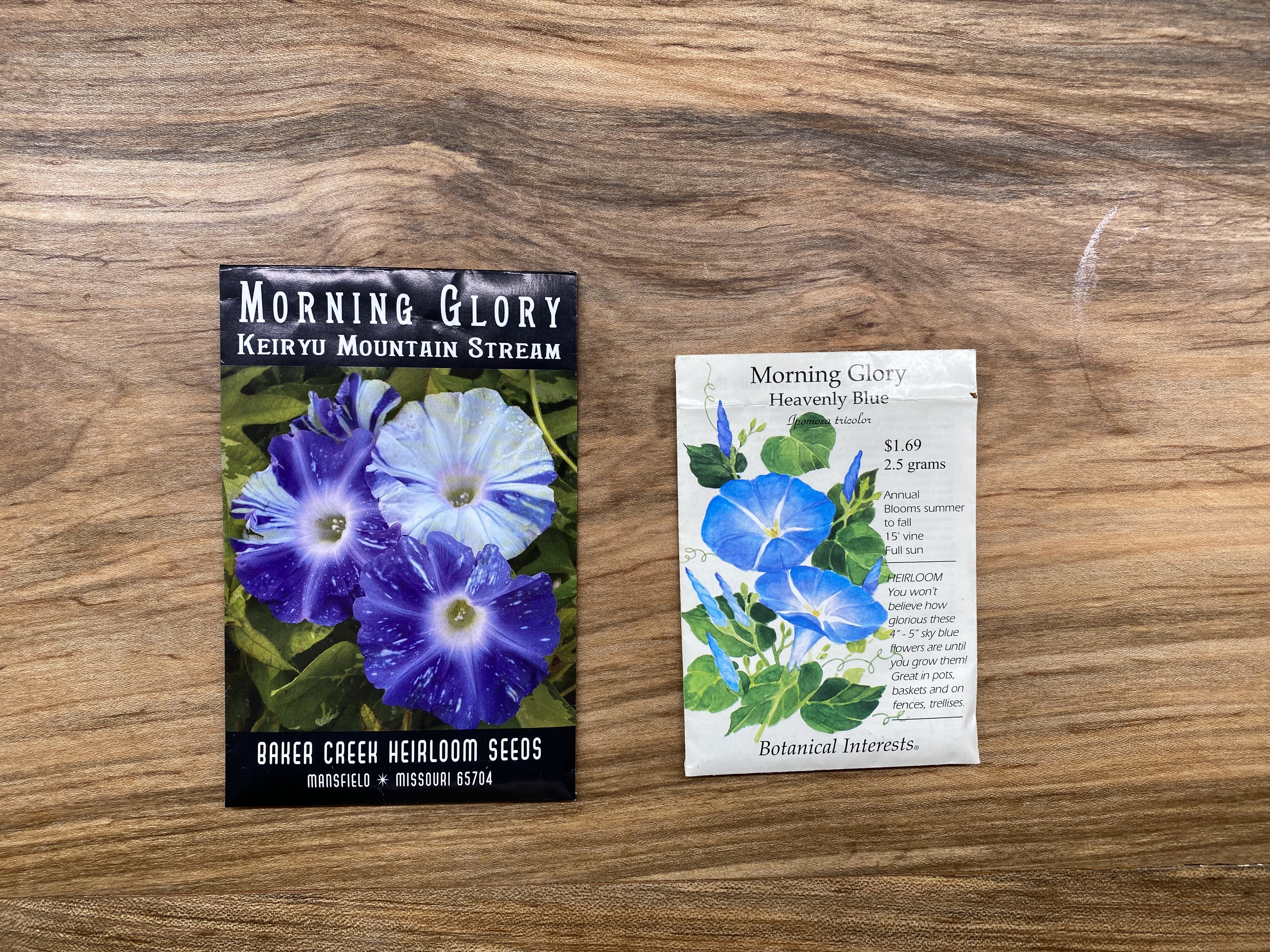
 There are some self-seeders I can count on and others that are a nice surprise.  The ones guaranteed to pop up are zinnias, amaranths (Love Lies Bleeding and Chinese Bicolor), Cocks comb, carrots, celery, chard, Giant Leaf mustard, purple sprouting broccoli, Hummingbird vine, Morning glory, Red Malabar spinach, and Giant Blue Feather lettuce.  I will also get different varieties of other lettuces popping up here and there and usually Chinese Hilton cabbage.


This year, I will sow self-seeding flowers like zinnias, Snow in Summer, and cock's comb on our hillside that is too steep to mow to add color, pollinators and seeds for birds.


Edible stand bys

Beans-Chinese Red Noodle, Taiwan Black and Yancheng green yard long pole snap beans, 1500 Year Old bean vine on one trellis and Christmas speckles lima beans around another trellis

Plant with Hummingbird vine and Red Malabar spinach with it.

Urizun Japanese winged bean in a pot as it loves the heat, if needed brought in 1 to overwinter

Okra-Red Burgundy (2 in the garden bed)

10 tomato plants-large paste (Italian Red Pear), slicers (5’ Cherokee Purple and an orange/yellow), a small fruit (Chocolate Pear), Long Keeper storage tomato, TV Brandywine, an early variety like Rubee Dawn, and Tropic VFN and Mannon Majesty from Southern Exposure Seed Exchange that are disease and heat resistant

4 eggplant-AO Daimura, Antigua or Rotanda Bianca or Rosa, Shiromaru or Amadeo, Qi YeRound (in pots)

4 cucumber-Aonaga Jibai, White Heron, Shintokiwa and Poinsett 76 that are disease resistant

1 summer squash-Trombetta since it is resistant to vine borer, disease and squash bugs

2 winter squash-Butternut and fun other one

Perennial onions-potato onion type, sweet and white Egyptian Walking onions

Garlic and Shallots-Hardneck garlic, Elephant garlic and shallots

Potatoes-Purple from true seed and Yukon Gold in the potato boxes

Snow peas in pots with peppers and eggplants

Dragon Tail radish in pot by sprouting broccoli

Cabbage-Hilton Chinese cabbage (2 plants) and 2 Savoy Perfection

Spring Greens-Lettuce (Royal Oakleaf, Grand Rapids, Butter King, Bronze Beauty, Celtic, Forellenschluss, Romaine, Giant Blue Feather, Yedikule, Red Sails) and spinach in pots

Summer Greens-Orach, Amaranth, Chard-Perpetual Spinach and Fordhook, Chinese Multicolor Spinach, Purple Stardust Iceplant, Komatsuna, Giant Leaf mustard, New Zealand spinach in pot

Herbs-Dill, Basil (Nunum, Genovese, Cardinal), Cilantro, Lion's Ear, Rosemary, Parsley, Garden Sage, Chervil, Pink Celery, Multicolor Sage, marjoram, rosemary

Sweet and hot peppers-overwintered Chiltepin, Jigsaw and Baklouti hot pepper plants, and 3 sweet pepper plants (Doe Hill Golden Bell storage, burgundy from save seed, Nadapeno)

Strawberries-will restart Alpine varieties Mignonette and Regina as they did not make it through the summer last year.

Cantaloupe-Tigger melon, Prescott Fond Blanc


New Varieties to Try

Fruit-New Hanover and Mary’s Niagara ground cherry, Kiwi Blue honeywort, rabbit eye blueberry bush

Summer greens-new varieties of amaranth (Beetroot, Callaloo), Feaster Family Heirloom sweet mustard greens, Silver Ocean mertensia, Jewels of Opar

Flowers-buy short flame cock’s comb plants to interplant with marigolds around front of beds, Baby Blue Eyes, Baby Blue Bouquet eucalyptus, Red Raven celosia, Copper Spotted petunias from seed, Raspberry Daiquiri Agastache from seed

Herbs-start Ginseng from seed, SimplyHerbs rosemary from seed, Irene rosemary plant

Tomatoes, cucumbers and beans-have included a few new ones in the top list of standbys to try that are disease and heat resistant since our summers are getting increasingly hot.  Will buy a large potted Better Boy tomato in May from the local nursery for early tomatoes.

Corn-bought some heirloom types of corn that are good to make flour from as well as fresh eating (Cherokee Gourdseed, Cherokee White Flour).  Not sure I will try them this year but is on my list for “soon”.

Squash-bought a disease and squash bug resistant summer squash Zapallito del Tronco that I may plant and 4 winter squashes that are also disease and squash bug resistant Musquee de Maroc, Buttercup, Canada Crookneck, Thai Kang Kob

Lawn alternative mixes-EcoEase Microclover (fine fescue and clover) and Fescue Lawn Mix and Alternative Lawn seed mix that has clover, flowers, and fine fescues in it.


I will also need to thin my Hummingbird vines, Morning Glory vines, celery, Red Malabar spinach and Giant mustard plants out as they come up next year.


I have to be stern with myself about what I will not plant.  In the past 5 years, I planted much less than usual and had plenty for fresh eating and preserving.  My eyes are always bigger than my space or need!!

Sunday, January 11, 2026

What's happening in the mid-January edible garden

Chinese cabbage "Hilton"

Sunday, January 11, 2026

In our Zone 7 garden, mustard greens, sorrel, chard, carrots, thyme, sprouting broccoli, lemon balm, oregano, rosemary, garlic, shallots, and onions are all still green in our January garden with no protection.  The peppers, basil, moringa, New Zealand spinach, Red Malabar spinach, bay and citrus plants over wintering in the house are also still green. My 1.5 year old Meyer lemon tree has its first baby fruit.

To keep your cold hardy crops going as long as possible, be sure to apply a good layer of mulch in the fall.  Frost forecasted? Here’s your to-do list  Preparing for a hard freeze

Austrian peas are a great winter crop to grow for salad greens.  I plant the seeds in the fall in pots.  They stay green all winter long with no protection in the garden.  I plant snow peas in the pots in the fall that I cover with a portable greenhouse.  The vines are about a foot long.  You can plant peas for early spring eating next month, as soon as the soil can be worked.  Time to plant peas!

Don't despair if your beet, leek, onion or carrot tops look a little worse for wear, the onion bulb and carrot under the ground are harvestable all winter.  All you need to know about growing carrots    Onions-everything you need to know to grow 'em     All about beautiful beets

Mulch is not only good for retaining moisture and keeping the soil cooler in the summer, but does the same in winter, keeping the soil warmer.  This lengthens the winter harvest and protects more tender crops so that they have a better chance of reviving in the spring to give an extra early spring harvest.  As your mulch breaks down, it adds organic matter to the soil.  Weed free, self fertilizing, till free garden beds

You can also use cloches, covers, and greenhouses to extend the harvest and get a jump on spring.   Biggest watch out when using cloches and green houses is to open when the sun is shining and temps get above freezing.  Temperatures can rise quickly inside the protection, killing the plants.  A row cover has more breathability, but that also means it will not keep the plants as warm.  See this blog for more on protecting plants  Extend the season with protection for plants   
Plastic row cover

I use portable greenhouses to cover the pots that I grow salad greens in year round.  Right now, there is different lettuces, arugula, chard, Italian dandelion, celery, parsley, sprouting broccoli, snow peas growing quite happily in the greenhouse.  Even in the Midwest you can get fresh food year round by planting winter hardy varieties and/or using protective covers.
Greens growing in portable greenhouse
You can start mache, parsley, leeks, peas, spinach and celery this week indoors.  For flowers, you can start lisianthus, Chinese lanterns, foxglove, eucalyptus, verbena, and drumstick flower.  Under a greenhouse cover or cold frame, you can start lettuce, spinach and other cold hardy crops.  For more on what to start in January, What to plant in the January 2026 garden

Saturday, January 10, 2026

What to plant in the January 2026 garden

Starting seeds in peat pods and Aerogarden
Saturday, January 10, 2026

For most of us, seeds started outdoors at this time of year will either become bird food or will stay dormant until it gets warm enough to germinate, unless started under some sort of cover.  If you have a greenhouse or hotbed, you CAN plant winter hardy plant's seeds under cover and they will germinate.  For most, January is the time to lay out 2026's garden plan, order seeds and start sowing seeds indoors for a head start on spring and summer harvests.  

For those that want to really get a head start on the spring garden, outdoor hot beds are a great way to get sturdy edibles ready to transplant.  Hot beds have been around for hundreds of years.  Before there was electricity, hot beds were heated by 18" of fresh and dried horse manure, covered by 12" of soil.  A pit was dug down so that the manure and soil were below ground level to keep the heat in.  It was covered by a wooden box with a glass angled to the sun.  Today, the same can be done.  You can also use a light bulb or heating pad to keep the temperature above freezing and below 55 degrees F.

There are cole crops that can be placed in hot beds and seeds sown even at this time of year.  Winter gardening in hot beds is successful even in Zone 4.  For Zones 6 and higher, you can sow things like spinach, kale and mustard greens in greenhouses and they will germinate, although slowly.  Be sure to keep the seedlings close to the ground for more consistent warmth.  For the edibles you have been overwintering in your greenhouse, come January 17th at my latitude in Kentucky, growth will really start picking up.  10 hours of daylight signals to most plants that spring is coming and it is time to start growing.

I grow greens during winter in pots under a portable greenhouse cover.  I will be sowing lettuce seeds in the bare spots this week.  When conditions are right, they will sprout.  You can do the same with any variety listed below for "hot beds".

If you are transplanting seedlings from indoors to outdoors, be sure to harden them to the conditions they will be transplanted to.  If in a greenhouse, cold frame or hot bed, you can take outdoors when temperatures are warm or maybe an unheated garage if the temps are close to the covered location you will be placing them.  "Hardening off" seedlings 

For more on cold season gardening, see Cold season crops for your edible garden and Winter edible garden.

January outdoor hot beds
Winter hardy lettuce transplants
Cauliflower transplants
Strawberry transplants
Cold hardy lettuce, kale, mustard seeds
Carrot seeds
Radish seeds
Spinach seeds
Austrian winter pea seeds

January yard, garden bed
Bare root fruit trees and bushes

For more on edible gardening in cold weather, How to extend the garden season.  

More popular is to start seeds indoors in January.  There are many seeds that can be started this time of year.  Take a look at your frost date and seed packet for the best time to plant for the variety you have seeds for.  Earlier is not always better!  If left indoors too long, the seedlings just get spindly and weak.  The seed packets share the earliest to start your seeds.  It is fine to wait until later.  In our Zone 7, the average last spring frost date is April 2, which is 13 weeks from now.   Frost date look up

January edible plants-indoor seed starting
12-16 weeks before last frost
(Our last frost is April 2 so this would be Dec 11-Jan 8 in our area)
Cabbage
Celery and Celeriac
Corn Salad (Mache)
Onions
12 weeks before last frost (Jan 8 in our area)
Artichokes
Parsley
Peas
10-12 weeks before last frost (Jan 8-Jan 22)
Endive
Escarole
Leeks
8-12 weeks before last frost (Jan 8-Feb 1)
Eggplant
Kale
Kohlrabi
Mustard
Spinach
Sprouting broccoli

There are many flower seeds that can be started in January as well.  Butterfly weed, Chinese lanterns, Drumstick flower, Angel's trumpet, Delphinium, Sweet William, Foxglove, Eucalyptus, Blanket flower, Helianthus maximilliani, Hollyhock, Lisianthus, Lupine, Pansy, Petunia, Prince's feather, Black-eyed Susan, Snapdragon, Stock, Verbana, Yarrow are a few that can be started indoors in January. 

I find this planting calculator helpful Planting calculator  to see what crops and flowers to start seeds indoors, outdoors and when to transplant.  You just plug in your last frost date and it will calculate the dates for you.

You can also grow sprouts and wheat grass indoors to keep yourself in fresh greens if you don't have a greenhouse going.   Grow super nutritious sprouts indoors

Sunday, January 4, 2026

January 2026 Edible Garden Planner

Sunday, January 4, 2026

As a new year begins, gardeners dream of the possibilities for their spring and summer gardens.  Big box stores have seeds in stock and all the seed starting supplies you need to get a jump on the spring season in January.  My biggest issue is paring down all the plants and edibles that look fun and fabulous to grow to what can actually fit in my small space garden and pots and is easy to manage.

Grow what you love!
The easiest way to fall in love with gardening is growing what you love to eat and look at.  There is nothing like strolling out to the garden to see what's ripe and tasty for dinner and gathering blooms to bring inside for the table vase.  If you have ever wanted to plant a kitchen garden, but weren’t sure if you had the space or skills, you may be surprised how little space is actually needed.

We grow all we need for fresh eating and putting away for the winter in our flower beds and pots.  Just mix in greens, herbs and veggies with your flowers and bushes.  Add edibles to your decorative pots.  It looks great, flowers attract beneficial insects for more veggie production, and is so easy to run out and get what you want to eat that day right outside your door.

If you aren't sure you can grow veggies, start with herbs.  Herbs thrive on neglect so are a great choice for dipping your toe into the edible gardening arena.  This is how I transitioned from a purely ornamental garden to integrating edibles into my flower beds.  A bonus is many herbs are perennials so only have to be planted once and come back year after year.  

Herbs come in all different sizes as well.  I love growing creeping thyme between stepping stones and around the perimeter of the garden.  Thyme is also a vole deterrent.  Oregano and tarragon are taller and have a tendency to fill out a space so better suited for the back of the garden.  And there are many in between.  Pick herbs that you use a lot in cooking and use those in your flower bed as a start.

You can grow a lot in a small space
It is common for Italians and French to have a small kitchen garden where they grow herbs, greens and vegetables year round.  It is amazing the amount of food you can grow in a very small space!  How to decide what to plant for small spaces?
If you have only a 6’ x 6’ space, a Mediterranean kitchen garden could include the following:
Herbs (1 each)-thyme, rosemary, sage, oregano, and flat leaf parsley 
3 basil plants (for pesto and seasoning)  
2 tomatoes-1 small fruiting and 1 slicer type 
2 sweet pepper plants  
1 zucchini (look for “bush” types as they are more compact)  
1 eggplant 
8 red bunching onions 
8 garlic plants 
Arugula, spinach and lettuce scatter sowed  

For more details on a compact French garden:  Small space French kitchen garden
For an Italian garden:  Heirloom Sicilian kitchen garden  To entice the little ones, chose a theme like "Pizza or Spaghetti Garden".  For those that lose interest in waiting, plant crops that have something for little ones to snack on from spring through fall.  

Use your patio to grow edibles with flowers 
If you also have room for pots on the patio, you can grow zucchini, eggplant, peppers and cucumber in pots  (only 1 plant in each pot) and add 3 bush or 6 pole bean plants in the garden bed or pot with a trellis for them to grow up. Look at the descriptor on the seed package to see which type the bean plant is.  Personally, I stick with the pole beans you eat whole as shelled beans you do not get as much food per plant, and less food per space in a small garden.  Pole beans produce all summer and fall.

If you have more room, you can add almonds (yes, they survive Midwest winters), beets, chard, fennel, chickpeas, figs (grows well in a pot too), asparagus, cardoon, chicories, radicchio, endives, broccoli, cauliflower, or artichokes.  

If you are just beginning a garden, do start small!  You want the garden to be fun and relaxing, not overwhelming.  Don't be afraid to begin.  The force of life is strong and really doesn't need much from us.  Buy a few plants in the early spring and just put them in the ground in a sunny spot with a natural fertilizer and you will be amazed at how they just go to town all by themselves!
Vintage WW2 poster
For seed catalogues, the ones that have the best chance of thriving in your garden are the ones that do their trials in your area of the country.  The seeds and plants they carry are the ones that have performed the best for them in their trial gardens.  Baker Creek is fun because they specialize heirlooms and rare seeds from around the world and are here in the Midwest.  Territorial Seeds has a good summary in each section of growing tips and their seed farms are mainly in the Northwest.  I have had very good success with both.  I look for key words in the packet description that reflect our growing conditions here in the Midwest summers.  This year, I also ordered from Southern Exposure Seed Exchange as they carry many varieties that can stand our summer heat and humidity.

My favorite catalogs are the ones that the links are on the right.  I have ordered from them all and been happy with their selection and how well the plants and seeds did.

After you have the list, pare it down to your space 
If you are like me, your list will be much longer than what you can grow in your space.  The hardest part for me is crossing off what I will NOT grow this season.  Split out what you want to grow by when they are producing in your garden, your cool season crops from your heat lovers.  If you start in early spring, you will want to plant the crops that grow well in cool temperatures like lettuce and spinach.  Spring edible garden  When all chance of frost has passed is when you will plant the heat lovers.  A summer edible garden  If you are just starting, start small and only try 2-3 of your favorites so you can easily care for them and learn about gardening.   

Here's how my garden fared in 2025, what I learned and my garden plan for 2026  Reflections on the 2025 garden and the 2026 garden plan  I have started ordering my seeds and plants for my 2026 garden and will update my plan with the new varieties that I think I'm going to try.  I'm sure my plan will continue to change slightly with how well my seeds come up and what looks enticing from the seeds I already have.

I'll start looking at my seed starting calendar soon.  There are varieties of edibles and decorative seeds that you can get started in January.  I'll have more seed starting in February and then my biggest month for seeds is March.  For more on what you can start indoors and outdoors in January:  What to plant for the January 2025 edible garden

Still having trouble deciding?  Well, you have some time before the season starts.  Heck, you can procrastinate all the way to June..........  It is not too late to start a garden in June!  You can use this time to make your plan based on what you eat this winter.  Use this winter to figure out what to grow in the ...