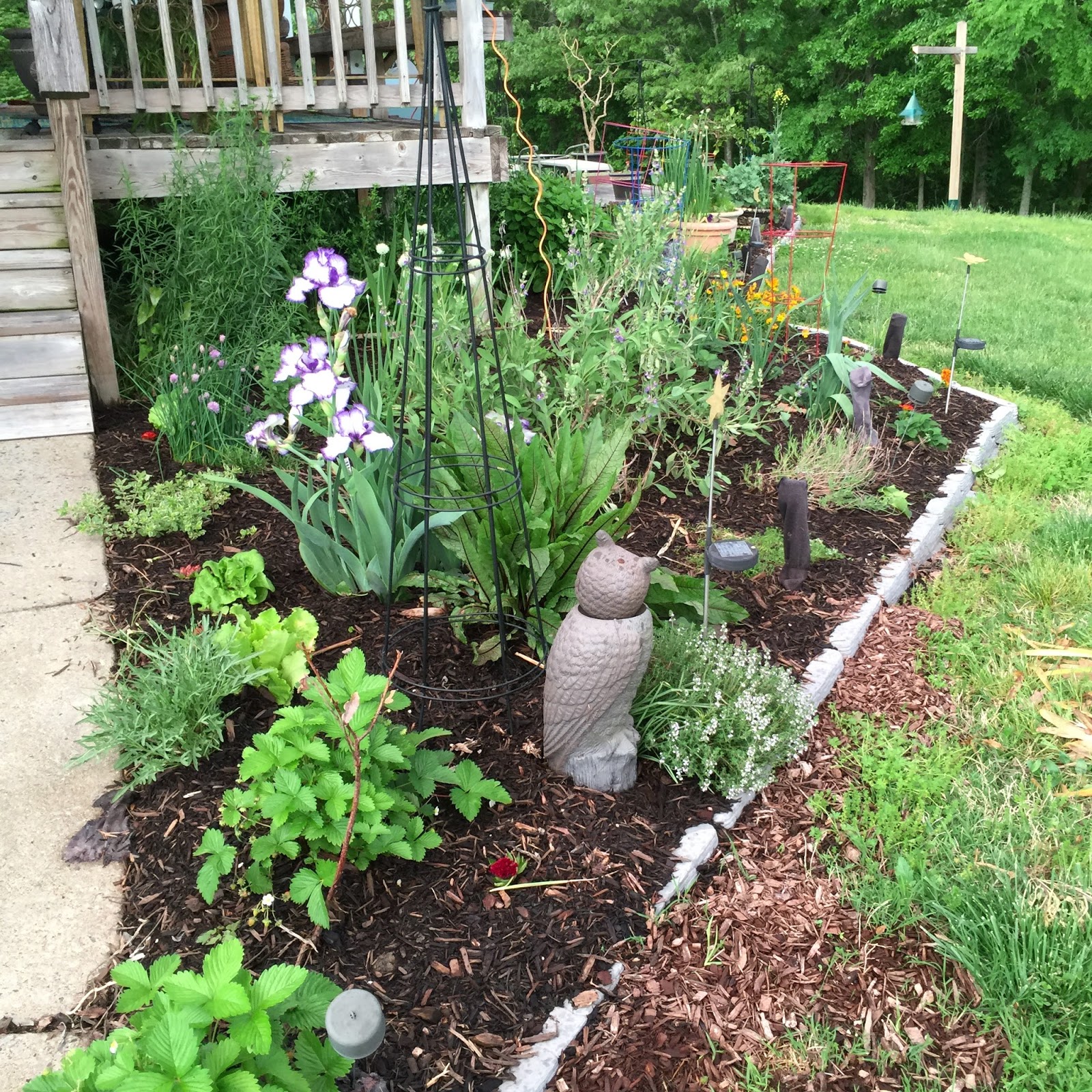
Sunday, June 25, 2017

July 2017 Edible Garden Planner

Zucchini, white cucumbers, tomatoes and green beans from the July garden
Sunday, June 25, 2017

July is the time of year for harvesting the heat lovers like tomatoes, eggplant, zucchini, cucumbers, sprouting broccoli, green beans, all types of peppers, garlic, basil with other Mediterranean herbs.

Peppers, zucchini, cucumbers, and green beans are ripe and being harvested.  My tomato plants have many baby tomatoes and are typically ready to start harvesting by the 4th of July.  I'm not sure if they will make it this year.  My eggplants have many flowers, but no fruits so far.  They love this heat and humidity so should be producing within the month.

By the end of the month, there will be more summer veggies than we can eat and we will start preserving the extra.  Preservation garden

The spring greens have bolted, but there are summer greens that are robust during the hot days of summer.  My favorites are salad burnet, Swiss chard, collards, Malabar spinach, mustard greens, New Zealand spinach, orach, sorrel, sprouting broccoli and cultivated dandelions.  Growing summer salads

The spring lettuce has gone to seed.  When you see the white fuzzies, they are ready to save.  I just pull the seed heads, break apart, put in a ziplock freezer bag, label with type and date, and store in the refrigerator.  I also re-seeded our self watering pots with some of the seeds.  I had a few small volunteer lettuce plants elsewhere in the garden that I transplanted to the pots as well.  The lettuce seeds I planted last month have sprouted and are ready to transplant.  Never ending salad from one packet of seeds  I'm going to start some more seed to keep the harvest going.  Succession planting is key for keeping lettuce in the heat of the summer.

There are even a select few varieties of lettuce that can stand up to summer heat:
Leaf lettuce-”New Red Fire”, “Simpson Elite”
Butterhead-”Optima”, “Winter Density:
Romaine-”Jericho”, ”Green Towers”
Batavian-”Magenta”, “Nevada”
If you haven't already, now is the time to plant these heat champions.  Bolt-free, sweet summer lettuces
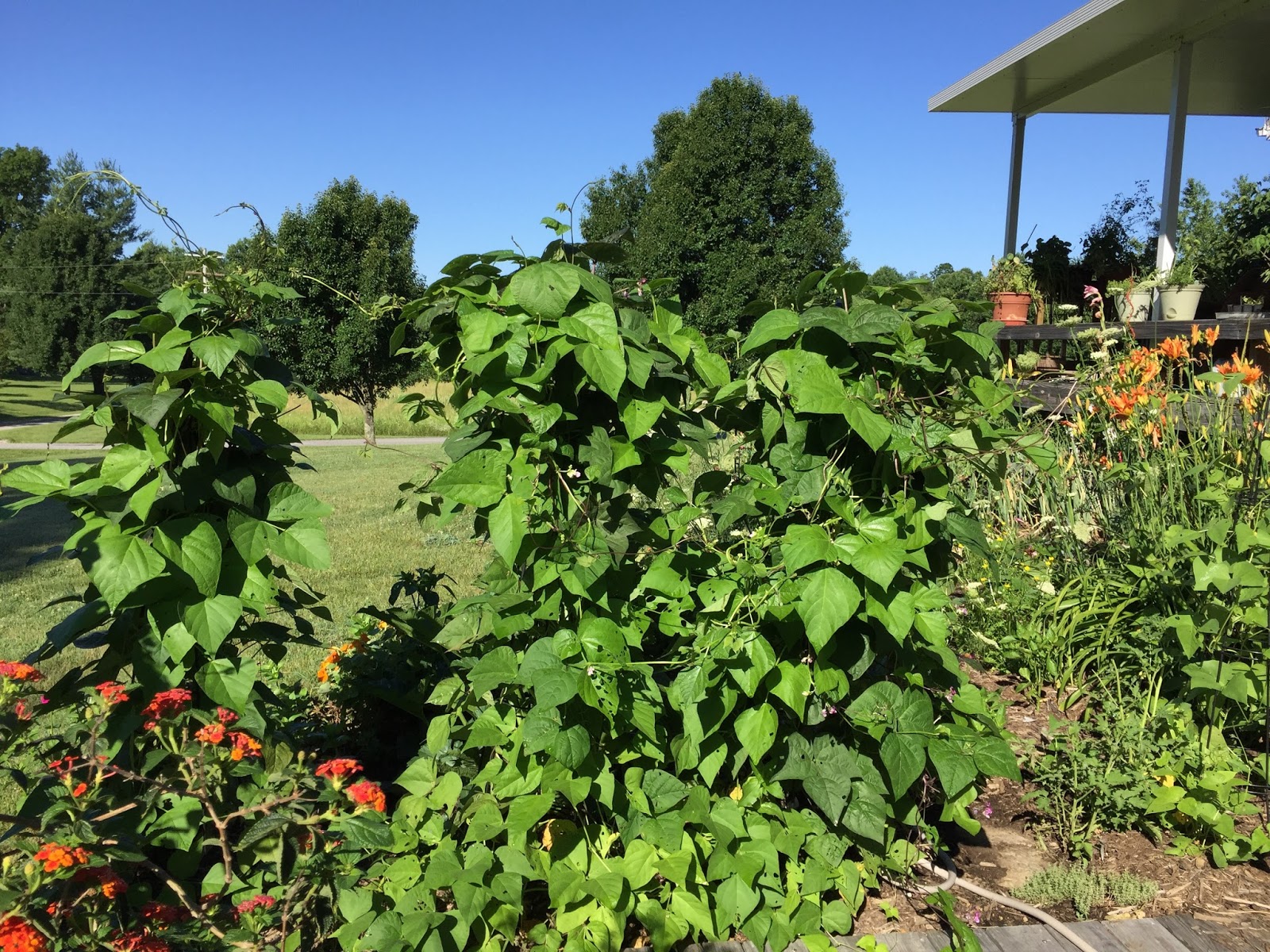
Pole green beans on trellis
The pole green beans are putting out beans consistently.  Harvest them to keep them producing.  I keep a quart bag in the freezer and add mature green beans as they are ready for picking.  The other legume, my snow peas, have finished producing for the season.  I love to eat them right off the vine.  There was a bumper crop this spring so I have frozen the extras.  Legumes-peas for spring, beans for summer

I have already harvested the garlic, including the elephant garlic.  I love elephant garlic as the cloves are as their name suggests, they are huge!  I am hardening both types in the shade outdoors for two weeks before storing indoors.  Hardening is critical for the garlic to not rot when stored.  Save the biggest cloves for replanting in the fall.  Garlic harvest time is near!

Our basil has been slow to get started but is now off to the races.  The trick to keeping the plants from getting woody is to make sure to harvest down to the first few sets of leaves before the plants go in to full flower.  It will regrow to give me at least one more good harvest before fall.  Basil basics-harvesting, preserving, growing basil

Oregano, mint, and catnip is in full bloom.  The bees love the small lavendar flowers!  It could be cut and dried now, but I love the flowers, too, and will wait until fall.  Make your own "Herbes de Provence"

I fertilized all the pots again as well as the basil to keep it growing.  Pots lose nutrients at a much higher rate than garden beds.  I am using a foliar spray on all the plants at least every other week and using a solid fertilizer monthly around each plant.  I like Espoma.  I use their tomato fertilizer for all fruit producing plants and their general purpose vegetable fertilizer for all other veggie and herb plants.  Decorative container gardening for edibles

I have started using a mineral supplement for my plants this year.  Right now I am using Azomite.  So many soils are low in minerals.  Your plants can't absorb what the soil does not have.  Adding minerals to the plants and soil will significantly increase the minerals in the plant itself, giving you minerals in the veggies you eat.  The next step in garden production and your nutrition-soil minerals

A key to keeping the garden productive this time of year is to keep even moisture to all the beds and containers.  Water the beds weekly and deeply.  During hot, dry periods, your containers may need watering every other day.  Self-watering pots with reservoirs in the bottom are the trick to extending watering duties.  Summer garden tips

If you are getting higher than normal rainfall, you'll need to fertilize more often as the rain will wash away the nutrients.  Keep an eye on the the growth of your veggies and if they are not growing and producing as expected, they may need some extra food.

The wild blackberries are ripe and ready for picking right now.  You have to get them quickly or the critters will beat you to it.  The Alpine strawberries are producing well.  Giving them a good fertilizer boosts the size of the fruits.  Alpine strawberries are super sweet, but small.  The apples are starting to turn red.  The fig tree is full of small green baby figs.  Looks to be a bumper crop for the figs.  I'd like to dry some this year.

Finally, the summer flowers are going gangbusters.  The zinnias, daylilies, marigolds, sunflowers, echinacea as well as the herbs like oregano, sage, and thyme are all in full bloom.  The hollyhocks, Cock's Comb, Love Lies Bleeding, delphiniums, morning glory, hummingbird vine, sedum are all in bud and will be blooming soon.  The mustard, carrots, broccoli and lettuce have all bolted and are flowering.  The bees just love their tiny flowers!  Flowers are not only beautiful, but attract pollinators making the garden more productive.
A butterfly on zinnias in the edible garden

Saturday, June 17, 2017

What's happening in the mid-June garden


Potted pepper plant with blooming nasturtiums

Saturday, June 17, 2017

This is the in-between season in our garden.  The spring veggies have wound down and the summer veggies are just starting to fruit.  The spring flowers are long gone and the summer lovers are just beginning to bloom.

The spring crops like lettuce, spinach, broccoli, cilantro, mustard, sorrel, chard, rat's tail, snow peas are at the end of their peak.  The lettuce, spinach, sprouting broccoli, cilantro, sorrel and mustard greens have gone to seed.  You can still pick leaves, but look for the ones at to bottom of the lettuce and cilantro plants where they are still sweet.  For the chard, sorrel, cultivated dandelions, and mustard greens, the new leaves are the sweetest.  Seed saving-fun, easy and a cost saver

I started a second crop of lettuce a couple of weeks ago.  They are about 2 inches tall right now.  Be sure to sow seeds of heat tolerant varieties; every three weeks is optimal to be able to have continuous lettuce harvests.  Bolt-free, sweet summer lettuces  

There are other greens that can be used for salads that thrive in the heat.   Chard harvested first thing in the morning, dandelion greens, sorrel, mustard greens and chick weed are all salad worthy.  You can add herbs for a fresh taste and zing like salad burnet, parsley, basil, dill, onion stalks/tops, chives, thyme, oregano.  For fun, you can add edible flowers.   Growing summer salads

The tomatoes are all flowering and have baby tomatoes on them.  Some have grown into tall, sturdy plants; others are still on the small side.  When tomatoes, squash, peppers and eggplants first flower, it is time to give them a boost with fertilizer.  I use a tomato fertilizer on all my fruiting plants as it is designed to boost the fruiting of plants.  I'll watch the plants that are not growing as well and give them another round of fertilizer in a couple of weeks.  With fertilizer on fruiting plants, you don't want to over fertilize or they will grow lots of greenery and not so many veggies.  Tomatoes 101, everything you need to know to grow great tomatoesI used a combo of Espoma Tomato Tone and Azomite to give the plants the minerals they need.  Minerals in the ground is minerals in the plants and fruits which gives you minerals when you eat them.  I have seen a real difference in plant growth using Azomite.  Another mineral supplement I am going to try is a Sea Mineral supplement to see how that compares. I always put the fertilizer under the mulch to make sure it all goes to the plant and not lose the nitrogen into the air.To keep from having blossom end rot on tomatoes and squash, consistent water is key.  They shouldn't be overwatered.  Over or under will affect the fruit flavor.  They are kind of like Goldilocks; they like it just right.  No worries, though, if you do overwater, the fruit will be fine, just not as flavorful and may crack.

Zucchini plant in bloom

We are harvesting zucchinis both the green Cocozelle and the Early Prolific straighneck yellow ones.   You need to keep a close eye on the zucchinis because they seem to get huge overnight!  The more you pick veggies, the more the plant produces for you.  What to do with all that zucchini?!

Close up of zucchini plant with growing fruits
The winter spaghetti squash had nice sized fruits growing until our chickens ate most of them, but they are still flowering so more will come.  They will not be ready to harvest until late fall.  They also tell you when they are ready.  When the vine dies, the squash is ready.  Growing zucchini and summer squash

The pepper plants have blooms and small peppers.  The Ancient Red sweet peppers are furthest along because they were overwintered.  They are turning red and are ready to eat.  Peppers seem to have a built in counter.  They will drop flowers when the plant has reached its max peppers.  Pick the peppers when green to keep the plant producing. You can ripen on the counter, if you like, or go ahead and enjoy green.    Preserving peppers
Our cucumber vines, which I have growing up a trellis to save space, is giving about a cucumber a week.  One cucumber is enough to make a jar of sandwich pickles.  My husband loves sandwich pickles on his burger.  Any extra I put in salads.  They taste so fresh right off the vine.  Make your own pickles without a store bought seasoning mix
We started pulling the garlic a couple of weeks ago.  Soft neck and hard neck garlic are slightly different in telling you when to harvest.  Soft neck garlic is ready to harvest then the tops fall over and die off.  They are ready to harvest about a week later.  Typically this is mid-summer, but ours is ready now.  Hard neck garlic is ready to harvest when about half of their lower leaves have turned brown.  Try digging one up and see if the bulb is large and firm.  After pulling, keep in a warm shady spot for 2-3 weeks for the bulbs to harden.  Hardening lengthens the storage time.  Save the biggest cloves for planting in the fall.  Garlic harvest is here! 
The snow peas are about done; they don't like the heat.  The beans are all flowering.  The storage beans have actual bean pods on them.  Storage beans will need to stay on the vine until the beans in the pods have reached full size.  Then you take them off to fully dry and hull them.  The green beans you want to harvest much sooner so that they are sweet and pods are not fibrous.  The more you harvest green beans, the more the plants give you.  I plant the vining types.  They will produce until frost.  Legumes-peas for spring, beans for summer
Background-potatoes blooming potato box.  Foreground-pepper and snow peas in pot with nasturtiums

All the herbs are going strong.  Many are large enough now to cut and dry for preserving.  Harvesting and drying herbs  The sage has been putting on lots of lavender blue flowers that the bees and butterflies love.  My mother read recently that you can use sage tea to help with hot flashes.  You can have up to 5 cups of tea a day.  Make your own teas from garden grown herbs

We are now into summer temps; most days in the 90's.  The garden will soon need supplemental watering.   Summer garden tips  For veggies I am growing in pots, I am watering them twice a week now.  The best veggie pots are those that have a reservoir in the bottom.  This will allow you to probably get away with watering once a week.  At some point, I'll remember and take the time to add a reservoir to my existing pots over the winter to cut down on the summer watering time!  Decorative container gardening for edibles

The hard part of gardening is over now.  There is minor weeding and occasional fertilizing along with watering.  Most of the time from here out is just harvesting, enjoying and preserving.

Monday, June 5, 2017

June 2017 Edible Garden Planner

Lettuce in foreground, herbs in background

Monday, June 5, 2017

June is a productive time in the garden.  Cool season crops are peaking while summer crops are just starting to produce with herbs in full swing.  Everything is a lush green at the beginning of the month.  As June gets in full swing, it will be time to begin regular watering.  As your fruit producing veggies flower, they will need a boost of fertilizer.  As the rain slows down, consistent ground moisture is key.

What’s growing in the garden right now
Most of the lettuce I planted in March is bolting.  The seeds started in April are transplanted and of a good size.  The resown lettuce from last week are starting to sprout.  I will replant these into larger pots as they grow.  I'll put them in pots so I can keep them in a cool spot as lettuce doesn't like it hot!  Overwintered sprouting broccoli has their small florets for use in salads.  Don’t worry about insect damage to the leaves on cabbage and broccoli as long as the heads are forming nicely.  A little insect damage will not affect the quality of the head produced.

When I get an infestation of caterpillars, I like to use diatomaceous earth (de).  It is made of tiny aquatic fossils from fresh water.  Their hard edges cause scratches on caterpillars and insects resulting in dehydration.  So no chemicals involved.  I use them only on plants that don't flower as de will kill pollinators, too.

Arugula, sorrels, chard and cultivated dandelions are all harvestable.  As it gets hotter, these greens become stronger.  Since they are perennials, they are the first up in the spring for fresh salads.  Harvest the new leaves in summer for the mildest taste.  You can cut them back, too, to get fresh new leaves.  It doesn't hurt them at all.  

I have done two harvests of spinach and frozen them in quart freezer bags.  What is left is starting to bolt.  The leaves are still sweet and great to use in salads.  Another salad addition that is ready to eat are snow peas.  The plants are just covered.  I harvested them this morning.  Usually the snow peas are ready when the lettuce is so they are a tasty addition to salads.  This year, the lettuce was way ahead of the snow peas.  Snow peas are also good steamed and in stir fry.

The cilantro, rosemary, sage, chives, savory, oregano, basil, lavender, dill, tarragon, parsley and thyme are filling out nicely and flowering. The chives have already bloomed with their beautiful lavender flowers.  The flowers are edible, too.  They are fun to use in salads or as a substitute for onions in cooking.  Very pretty to add in baked potatoes and grill.  We slice our potatoes, add some diced onion or chive flowers, butter, seasoning, wrap in foil and throw on the grill.  Yum.

Another great thing about herbs is they are a good deterrent to deer.  Deer do not like strong smells so avoid fragrant herbs.  I plant them all around the garden to keep the pesky critters away.  We now live out in the country and deer will even bed down in the yard.  What has worked to keep them out of the garden is a combination of a pod deer deterrent, WD40 on socks, herbs, and marigolds around the perimeter of the garden bed.  
Flowering chives

Tomatoes, cucumbers, peppers, eggplant, and squash are all flowering.  Keep an eye out for cucumber beetles and caterpillars.  Just pluck them off and throw into a can of soapy water.  My overwintered pepper plants are full of peppers of harvestable size.
How to control bugs naturally, organically

Overwintered carrots and beets, onions, garlic, and leeks are all flowering, including the Egyptian walking onion.  I am harvesting the walking onion any time I need onions for cooking.  The green stalk is great as a fresh chive, too, for salads or potatoes.

The early strawberries have come and gone.  The Alpine strawberries are ripe for the picking.
Ripe Alpine strawberries
Now is the time to provide shade for your lettuce and sow bolt resistant varieties like Summer Crisp Magenta, Green Towers and Jericho Romaine, Simpson Elite leaf.  The Grand Rapids is doing quite well in the heat.  You can move your lettuces if in pots to a shadier part of your patio or porch.  Shade cloths can be used for those in the garden.  You can also plant taller veggies on the south and west side of your lettuces so as they grow, they provide shade to the lettuces.  I move most of my greens around to the northeast, shady side of the house this time of the year to keep them sweet as long as possible.  
Bolt-free, sweet summer lettuces

For a spinach substitute, you can grow New Zealand spinach.  It has spinach taste and loves the heat.
Growing summer salads

Best time to harvest
The best time to harvest almost any vegetable is mornings or right after a rain; this is when they are the crunchiest, fullest and sweetest.  Harvest greens in the morning before you go to work and store in the frig for the day.  Just don’t store tomatoes in the frig; this ruins the flavor.

The best time to harvest aromatic herbs like rosemary, thyme and oregano is in the afternoon when the oils are most concentrated.  Harvest herbs like parsley, cilantro and dill in the cooler part of the day.

For more tips on preserving the extra, see Preservation garden

Watering & fertilizing tips
With the heat coming, it is time to start watering.  Keep consistent moisture to your lettuces to keep taste sweet and your lettuce from bolting as long as possible.  When your lettuce does bolt, let it go to flower and seed.  The bees and beneficial insects enjoy the flowers and the seeds can easily be saved for fall and next spring planting.  

Fertilize all your fruit bearing veggies when the first flowers appear (right now we have flowers on our cucumber, zucchini, peppers, eggplant and tomatoes).  Provide only compost tea or kelp the rest of the season.  Too much nitrogen will cause your plants to grow lush foliage with no fruits.  Nitrogen stimulates green growth.

For more on summer garden care, Summer garden tips

Can I still plant a garden in June-Yes!
There are many vegetables and herbs that you can still plant right now.   Any of the summer vegetables love these temperatures and sun.  As a matter of fact, this is the best time to plant cucumbers and zucchini to avoid the vine borer.  Even if you have planted zucchini and tomatoes already, late June is a good time to plant a second crop.  The cucumber seeds I planted a couple of weeks ago rotted so I am re-planting.  Many gardeners have had this happen to them with all the rain we are getting this spring.  

A complete list of all veggies that can be planted in June:
Arugula
Bush beans
Beets
Broccoli
Broccoli raab
Brussels sprouts
Cabbage
Carrots
Cauliflower
Chard
Collards
Corn
Cucumbers
Eggplant
Bulbing fennel
Kale
Leeks
Mediterranean herbs (basil, thyme, sage, oregano, rosemary, chives)
Okra
Parsnips
Salsify
Summer squash
Sweet potatoes
Tomatoes
Turnips
Watermelons


Savory, thyme, lettuce, onions with day lilies in the background

Here are a couple of garden ideas

If you have a picky eater, try the kid’s pizza/spaghetti garden.  If they grow it, they want to eat it!
Tomatoes-any you can’t eat, you can easily freeze for winter pizzas, salsa, or sauce
Basil, oregano, chives, garlic for seasoning
Onions-you can grow Egyptian walking onions in a pot or ground and they are perennials to boot
Kale, arugula, broccoli and peas for spring and fall pizza toppings (also easy to freeze for later)
Green peppers, eggplant, zucchini for summer pizzas (maybe some hot peppers for the adults)
For those that are real adventuresome, you can get mushroom kits to grow mushrooms.

Or if you want a culinary garden, here is an Italian/Sicilian garden that you can grow in as little as a 6’ x 6’ space:
Herbs (1 each)-thyme, rosemary, sage, oregano, and flat leaf parsley
3 basil plants (for pesto and seasoning)
2 tomatoes-1 Roma type for sauces and 1 slicer type for salads
2 sweet pepper plants
1 zucchini
1 eggplant
8 red onions (you can substitute Egyptian walking onions)
8 garlic plants
Arugula, spinach and lettuce scatter sown

For other garden themes,
Small space French kitchen garden
Different lettuces in a decorative patio container

It is great fun, a time saver, and nutritious to grow your own food in your yard or patio!  For more on small space gardening, 
How to decide what to plant for small spaces? 
Decorative container gardening for edibles 
Get the most from your space-plant intensively! 
You can garden year round in small space 
Start a kitchen herb garden!

Thursday, May 18, 2017

Quick tip-What to start in the May garden

New seeds in pot
Thursday, May 18, 2017

There are many heat lovers you can plant in the mid-May garden.

The heat lovers to start in the garden now:  Beans-bush, vine and lima, Beets, Cantaloupe, Carrots, Corn, Cowpeas, Cucumbers, Eggplant, spring Kale, Lettuce (heat tolerant varieties), Okra, Peas, Peppers, Potatoes, Pumpkins and other types of Winter Squash (Acorn, Butternut, Turban, Hubbard, etc), Radishes, Summer Squash (Zucchini, Pattypan, Yellow Crookneck, etc), Sweet Potatoes, Tomatoes, Turnips and Watermelon.

Just be sure to keep the soil moist until sprouted and not to dry out until the seedlings are a nice size with a couple of sets of "true" leaves.  These are the leaves that develop after the initial set of leaves.

Just follow the seed packet instructions for how deep to plant and spacing.   I like to put the large seeds like squash, cucumber, beans and peas directly into the garden.  For the smaller seeds, I will start in a pot and then when they are a sturdy size, transplant them into the garden bed.

Chard and lettuce ready to be transplanted to the garden


Sunday, May 14, 2017

What's happening in the mid May edible garden

Herbs and lettuce in the garden

Sunday, May 14, 2017

Mid May is a wonderful time in the garden.  There are many greens for salads or steaming.  Herbs are growing robustly.  By this time of year, we no longer need to purchase produce from the grocery store and can get fresh herbs to add to ordinary dishes that make them taste wonderful.

The greens we are eating-French sorrel, chard, spinach, dandelion greens, salad burnet, corn salad, chick weed, sweet clover, green onions, tyfon, Giant Red mustard, sprouting broccoli leaves, snow peas, turnip greens.

Herbs to add to dishes and salads-chives, cilantro, parsley, rosemary, oregano, thyme, horseradish, overwintered leeks, Egyptian onions, tarragon, sage, dill, young garlic. 
The fruits and veggies-turnips, beets, strawberries carrots.

The flowers that are blooming-irises, marigolds, roses and the herbs and veggies going to seed-yellow flowers of the sprouting broccoli, white flowers on the cilantro, the sage has beautiful purple flowers, the white flowers of thyme, lavender chive flowers.  All veggie and herb flowers are edible.  A fun way to add flavor and beauty to salads or other dishes.

The lettuce is beginning to bolt so soon there will be the white, yellow and blue flowers from the different kinds of lettuce.  A couple of the carrots are starting to bolt, too.  If not pulled, they will have beautiful flowers resembling Queen Ann's Lace, which they are from the same family.  

The peonies and late blooming tulips came and went early this year.  

Potted lettuce
This week end, I weeded in the garden and pots.  We got some horse manure compost from a local rancher and it appears it was quite full of grass seeds.  Most were smothered by the mulch, but some managed to make it through.  Small price to pay, though, for that great organic matter.  I also added Azomite, which is chock full of minerals, and an organic fertilizer to all the edible plants.  It has been about a month since my last fertilizing.  

It is a good idea to wait 10 days after planting new plants before you give them much fertilizer.  It has been that long for the pepper and tomatoes.  I used Espoma's Tomato-Tone on both since they are both fruiting vegetables so have similar needs.

There has been an insect feeding on my tomato leaves and something chewing off a few of my transplants at the ground.  I sprinkled diatomaceous earth (de) on and around only the plants that were being bothered.  De is not discriminate between good insects and bad insects so I use sparingly.  I would not use on a plant that is flowering to avoid killing pollinators.

Once the plants get up to a decent size, they will no longer be at risk of being killed or stunted from being an insect's meal.   
Foreground is Giant Red mustard, in the middle are summer veggies, background are onions

I have also had a very enterprising mole in the garden.  The good part of this is that they do a great job of loosening up the soil.  The bad part is that if there tunnels go under your plant, there is a good chance, the plant will die.  I got out the mole deterrent and put it in the garden.  It is just a round metal tube that vibrates and makes a buzzing noise a few times a minute.  Hopefully, it will keep the mole from the garden!

I have been harvesting the extra greens and freezing them to use when needed.  By harvesting, it stimulates the plant to grow even more leaves.  My spinach did much better this year in the pot and garden.  I was very generous with the fertilizer!  Preservation garden

I do have a handful of plants that did not make it when transplanted or were an insect meal.  I have replacements started in the pot.  Planted the seeds a few days ago.  Should sprout in 7-10 days then I'll let them get there first real leaves on and to a nice size before transplanting them back into the garden. 
Seeds planted in pot

Sunday, May 7, 2017

My 2017 Edible Garden Plan

Mid-May garden
Sunday, May 7, 2017

There are veggies and herbs I keep in my garden year after year and then there are the “experiments”.  I have my standby’s but I love trying new things each year.  New varieties or just new kinds of edibles.  I try new varieties to find the ones that are most prolific for my garden conditions and taste.

The perennials in the garden are your back bone.  They come back year after year with no effort on your part.  They are the first up in the spring and the last to leave in the winter.  If the winters are not harsh, many are harvestable year round.  Midwest Perennial Vegetable Garden

Edible perennials in our garden:
Herbs-lavender, bay laurel, rosemary, thyme, sage, mint, thyme, oregano, salad burnet, common chives, tarragon, horseradish, garlic, Elephant garlic, and leeks.  For more on growing herbs, Start a kitchen herb garden!  I am adding a creeping thyme with various flower colors this year.  Our rosemary did not make it through the winter, even though it is hardy in our zone.  I am trying two new hardy varieties Tuscan Blue and Arp.  The sage was so large that I was able to take a good part from a self-rooting stem and replant at my mother-in-laws.
Vegetables/Fruits-Goji berry, potato onions, Egyptian walking onions, French sorrel, blood veined sorrel, chard, cultivated dandelions, strawberries, apples, figs.  Corn salad, cilantro and sprouting broccoli both came back from their own seed.  I also had many self seeders come back: carrots, tomatoes, corn salad, lettuce, and cilantro. 

I have annual herbs, flowers and vegetables that I grow each year.  Most I have to either start from seed or purchase bedding plants from the store.  There are some that self sow and will come back year after year with no effort on your part.  Self-seeding crops, plant once and forget 'em
Large seeds are started in peat pots with starting soil and small seeds in the Aerogarden on right
Edible annuals I can’t live without that I have in my garden this year:
Herbs-celery (Utah), cilantro (Slo Bolt since our springs are short), basil (Lettuce Leaf and Genevose for cooking and pesto), borage, Wild Zaatar oregano (from Jordan/Israel), two new varieties of sage (Blue Monday and Salvia Sirius Blue mainly for their blue flowers), dill, English thyme and chervil for cooking and adding to body oil.  I have to have parsley in the garden.  It is a self-sower and usually comes back each year, which it did this year so no more are needed.  
Vegetables/Fruits-Solid red Terra Rose and solid blue Purple Majesty potatoes (started from seed potatoes), sweet peppers (Sweet Yellow banana, overwintered Ancient Red, Pizza, Feher Ozon paprika, Healthy), hot peppers (a Sicilian pepper Bocca Rossa, Ancho and Poblano for chili powder), summer squash (Early Prolific Straightneck and Cocozelle), green beans (vine types-Romano II, Scarlet Runner, Golden Sunshine Runner, Purple Podded and Bean Blauhilde), storage beans (Portal Jade, Good Mother Stollard and King of the Garden lima beans) and tomatoes (Cherokee Purple, Italian Red Pear an heirloom paste, Principe Borghese, Chocolate Pear, small and medium yellow storage tomatoes from Sicily, Black Vernissage, Lucid Gem, Patio Princess for the pot, and Rosella).  I always keep cayenne and jalapeño peppers in the freezer for salsa and cooking.  Right now, I don’t think I need to restock so I’ll wait and see on planting this year.

Other veggies I am doing this year are carrots, turnips (Purple Top and Golden), beets (Chioggia), tyfon for greens, Red Rubin brussels sprouts, many varieties of chard (Verde de Taglio, Bright Lights, Rainbow Neon Glow, Fordhook, Golden, Perpetual), Radish Rat's Tail, Spaghetti squash, Red Burgundy Okra, cucumbers (Mini White, Homemade Pickles, and Jaune Dickfleischige) and eggplant (Turkish Orange, Casper, and Kazakhstan).

For greens, I always plant and start a variety of lettuces, spinach and Giant Red mustard.  Lettuce plants purchased: Red Romaine, Buttercrunch, Red Leaf, Paris Island Cos, and Crisphead.  I'll need to start heat resistant types soon like Jericho Romaine and Simpson Elite loose leaf Bolt-free, sweet summer lettuces   I'll also have to so some Grand Rapids as it was one my Granny grew in her garden.  If you let your lettuce go to seed, you can save them and never have to buy lettuce seed again.  Never ending salad from one packet of seeds  I am also growing Dwarf Moringa.  It's a small tree that leaves are chock full of protein and can be used as a green.
Flowers interplanted with herbs and edibles
Annual flowers seeds started:
I always add flowers to the garden.  Not only do they look nice, they attract pollinators that increase yields.  Cock’s comb from seed my dad gave me years ago, Hummingbird vine from seed a neighbor gave me years ago, marigold (great deer and pest deterrent), sunflowers, Love Lies Bleeding amaranth, zinnias, Moonflower vine, blue morning glory, hollyhock (Summer Carnival and Peach), Roselle Red Hibiscus and delphinium.  For fun, you can add edible flowers to the garden.  Growing and using edible flowers

I started the most of the small seeds in the Aerogarden and the large seeds (squash, beans, Moonflower, cucumber, sunflower) I started in peat pots on a heating mat.  I planted the beans directly in the garden.

I decided against broccoli, cabbage or cauliflower this year because the beetle pests were awful last year.  All three of these are in the same family.  Without their preferred food this year, the pests should die off and I’ll plant back in the garden next year.

I plant the crops that like cool weather on the north side and where there is more shade to extend the season.  The heat lovers I plant where they get the most sun and won’t be shaded by others as they grow. 

I like to interplant flowers and crops.  This keeps the pests down by not planting one type of crop all together.  The flowers attract pollinators and can even repel pests. Get the most from your space-plant intensively!  Place this year’s crops in a different spot than they were last year.  Practicing crop rotation does two things.  Each type of plant uses different minerals and nutrients from the soil.  Smart rotation will keep your soil from getting depleted of what your crops need.  Rotation also keeps the pests down.  Crop rotation made easy for small gardens

For more on preparing your soil for plant (and crop) nutrition, check out this blog.  The next step in garden production and your nutrition-soil minerals

Last summer, my veggies just didn't seem to do as well as years past.  We got a lot of rain so that wasn't the problem.  By the end of the summer, we finally figured it out.  The rain was washing away the fertilizer faster than usual.  I applied a triple dose and everything perked up.  This year, I am going to keep a close eye on the growth of our plants and when they slow down, I'll be sure to give the plants some more food.

Saturday, May 6, 2017

For year round steamed greens, grow chard!

"Bright Lights" chard
Saturday, May 6, 2017

Chard is a wonderful green, chock full of vitamins.  It can be eaten when small in salads.  The large leaves can be harvested for steamed/cooked greens.  The stems can be steamed or braised as a substitute for celery.  Chard has been around for centuries.  It hails from Sicily and was known as sicula.  No one is quite sure how it became known as Swiss Chard.

It is also ornamental if you pick one of the many beautiful colored ribs-shades of red, orange, pink, yellow.  They grow tall when planted in the ground so make a great focus in the back of the garden bed.  Chard also does well in containers for small spaces.
Potted chard
It is a tender perennial in our Midwest garden.  It grows in all seasons.  One of the hardiest Swiss Chard is the heirloom Fordhook and Perpetual.  Only the coldest weather kills it back to the ground, if not covered.  It is one of the first greens to sprout in the spring.

Chard can grow in about any condition or soil, even shade.  For the mildest taste, plant chard in fertile soil and do not let get water stressed.  It appreciates shade in the hottest time of summer; heat stress can cause it to take on a bitter taste.  As it gets warmer, the white ribbed chard in our flower bed, "Perpetual Spinach", remains mild in taste, more spinach like than chard.  It is also the most cold hardy, surviving through Zone 6 winters.

Chard handles the summer heat.   Like most greens, the more you harvest it, the longer before it bolts.  Even with seed heads, the taste does not become too strong when steamed.  You should harvest the outer, lower leaves frequently to stimulate new center leave growth.  For the most succulent leaves, harvest in the morning or right after a rain.  Growing summer salads

Chard is easy to preserve.  Simply harvest the leaves, clean, dry and freeze.  I lay out my leaves on a cookie sheet and quick freeze, then put into freezer bags.  Freezing the extras for winter  Don't forget to label with the type and date; frozen greens all look about the same.  You'll want to use the oldest first.


Baby "Perpetual Spinach" Chard

Chard is a power house of nutrients.  It is an excellent source of vitamins A, B6, thiamine, C, and K; contains fiber, carotenes, chlorophyll, and several minerals-potassium, iron, manganese, calcium, selenium, zinc, niacin, folic acid and even protein.  To top it off, chard is very alkalizing for the body and considered one of the most potent anti-cancer foods.  SELF has a cool nutritional database for details on nutritional values of food.  For chard, Chard nutrition info

You can either start chard from seed  Indoor seed starting tips  Outdoor seed sowing seed starting times  Or you can pick up plants at big box stores or your neighborhood nursery.  Nowadays, they have many colors and varieties available as plants.  If you want more unusual types, seeds are a great way to explore.

If this is your first year gardening, here are a couple of gardening blogs to help you get started.  For a garden bed, Easy kitchen garden  For a pot garden in a small space, Decorative container gardening for edibles