Sunday, April 9, 2023

What's happenin' in the early April edible garden

Egyptian walking onions
Sunday, April 9, 2023

The I have been busy sowing seeds, putting transplants in the garden and pots, and fertilizing! I plant a combination of herbs, fruits, vegetables and flowers every year.  The flowers attract pollinators that help the fruiting plants like tomatoes and peppers to produce more as well as just looking good.

Status of our garden
My soil sample showed I needed a little potassium, some nitrogen and was getting a little high in alkalinity.  I added enough sulfur to bring the garden beds down from 7.7 to around 6.5-7.  Our local extension agent has told me in the past that if you are doing regular additions of balanced fertilizer that you likely don't need additional phosphorous (P) or potassium (K), but will likely need additional nitrogen in the spring throughout the growing season.  The next step in garden production and your nutrition-soil minerals

We didn't have any weeds that needed to be pulled before we mulched the garden bed last month so it is ready to be planted.  We have Egyptian walking onions, chard, sorrel, arugula, carrots, celery, lettuce, dandelions and plantain that overwintered and are going strong right now.  I use the bottoms of the onions in cooking and the tops like chives.  The greens I use in salads and also as wilted greens.

Looks like so far I have a rosemary that survived the winter in the garden.  Thyme, oregano, tarragon, celery, pea shoots, garlic chives all are green and ready to use.  I'll need to replant my parsley, sage, garden chives and cilantro.  Basil has to be started every year in our zone.  I plant sweet basil for pesto and cardinal basil for its leaves and beauty.    Start a kitchen herb garden!

The bay, kumquat, pepper plants, Nuun basil, lemon and grapefruit tree I overwintered in the garage are adding leaves.  The kumquat is full of ripe fruits and the pepper plant has a couple of peppers on it.  I moved them all outdoors this week as the extended forecast has the night time lows staying at least in the 40's.  They should be fine unless it gets below 28F.  

The lettuce and spinach seed I sowed in pots outside last month are sprouting.  When they get bigger, I will thin by transplanting the larger ones into the garden.  I bought some additional lettuce and spinach plants that I planted in pots last week.  They are looking quite happy.  Growing fabulous lettuce and greens

I dug up the volunteer garlic chives and celery and re-potted to give to the local master gardeners for their annual plant sale.  They are both winter hardy and prolific self-seeders.  My best performing self seeding edibles

April and May are fun to watch to see what volunteers will come back from last year's seed.  I will likely have marigolds, tomatoes, chives, squash, and lettuce plants pop up yet this spring as the soil warms.  Try self-seeding veggies and flowers

I took a look in the freezer and pantry to see what we were running short on to develop my garden plan for this year.   Edible garden plan for 2023   I'll take one more look at the end of the month to fine tune how many summer lovers I'll need to plant.   A summer edible garden   

I think I'll also try to go to the farmers market more this year to see if there are other fruits or veggies that do well in this area to add to the garden.  We have one that goes year round and another couple that are close by that starts up in early June.  You can find a farmers market near you through this web site.  www.localharvest.org

Saturday, April 8, 2023

Ready to transplant? Tips for success

Seedlings "hardening" outdoors on the covered patio
Saturday, April 8, 2023

This is the time of year that many small plants are getting planted in backyard gardens.  Here are some tips for giving your seedlings and transplants the best chance at surviving and thriving from the move to the garden.

For almost all of us that have started plants from seed indoors, we have experienced the sadness of our cute little seedling that we nurtured for weeks croaking after planting outdoors.  For myself, I can name a few reasons for the premature death of my seedlings.  Here they are along with tips for successful transplanting.

1.  Transplanting a seedling in a season too cold or too hot for when it likes to grow.  A good example is cilantro.  Cilantro does not like heat.  If you buy seedlings late in the season and transplant them into your full sun garden, they can quickly die or if they survive, they will immediately bolt into a flower stalk with no harvestable leaves.  Cilantro should be planted in early spring when temperatures are cool.  So first tip, only plant in the season that your veggie likes to grow.

2.  Transplanting near other plants that put out toxins in their roots.  Some trees like walnut and hickory and some plants like sunflowers put out exudes in their roots that are toxic to other plants.  Tree roots just by themselves can rob the vegetation near the tree of moisture and nutrients they need to thrive.  If your space is limited to those near trees, you can use raised beds with protected bottoms to keep tree roots from infiltrating the veggie's soil.

3.  Transplanting into an area of the garden that the plant does not get what it needs to thrive.  For example, fruiting vegetables like tomatoes need lots of direct sunlight to get big and bushy to support the energy needed to produce fruits.  Planting where they will only get a few hours of sunlight will result in weak plants that will struggle to produce fruits.  Another example is planting cool temperature loving plants in the hottest part of the garden.  Think southern exposure with no shade.  Crops like lettuce do enjoy 6-8 hours of full sun but produce longer with sweeter leaves if given afternoon shade.  If you grow in pots, you can have the pots with southern exposure until it warms up and then move to the east or north where it will be cooler in the afternoons.

4.  Transplanting seedlings with weak stalks.  If you handle seedlings by their stalk, you can crush the stalk which will kill the seedling.  Handle the seedling by its leaves if the stalk is thin.  If you transplant a seedling that has a weak stalk on a windy day or week, the wind can blow the seedling stalk in half, killing the seedling.  

5.  You'll have the best luck "hardening" the seedling to outdoor conditions gradually before planting in its permanent spot.  Take your seedlings outdoors when it is warm, gradually increasing the exposure to the sun and wind.  Like us, plants need to build up protection from the rays of the sun.  Exposure to wind causes the seedling to strengthen its stem.  You can gently brush your seedlings indoors daily or put a small fan to blow over your seedlings to mimic the outdoor wind.

  6.  Breaking the roots of the seedling as you are removing from their growing pot to put them in the ground.  Be as careful as you can to remove the entire root ball of the seedling.  Their root system isn't very robust when small.

7.  Transplanting too soon.  It is best to wait until your seedlings have at least their second set of leaves.  This signals that the seedlings root system is robust enough to support on-going growth.  

8.  Transplanting on a full sun day.  Even after hardening, the transplanting process is hard on a seedling.  I look for cool, shady days to transplant to give the plant some time to adjust before getting hit with the full power of all day sunshine.

9.  Not giving the transplant the water and nutrients it needs when you plant them.  I like to give the seedlings a good watering before I transplant them.  At transplant time, I add char, worm castings and a balanced organic fertilizer and mix into the soil of the planting hole before adding the seedling.  After planting, I water again and keep an eye on them daily for the first few days to make sure they are getting the moisture they need.  If a nice, slow rain comes the day after planting, this is the optimum for the transplant!

Sunday, April 2, 2023

April 2023 Edible Garden Planner

April edible garden
Sunday, April 2, 2023

April showers bring May flowers, fruits, herbs and vegetables!  Now is the perfect time to get serious on getting your spring garden planted and sown.  In April, I usually have seeds and plants going indoors and outdoors.  With all the selections they have at nurseries and big box stores, it is easy to skip this altogether and just buy plants you to have an instant garden!

Crops to plant in April
Early April is a perfect time to plant cold season crops like Brussels sprouts, fava beans, beets, broccoli, cabbage, carrots, cauliflower, celery, collards, kale, lettuce, mustard, onions, parsley, parsnips, peas, potatoes, radishes, shallots, spinach, strawberries, Swiss chard and turnips.  Local big box and nurseries have a variety available to put in your garden right now.  Outdoor transplant calendar

See this post for what to plant in April as well as links on how to grow each veggie.  What to plant in the April edible garden

We have fresh salads from the garden now.  The greens that overwintered are arugula, cress, lettuce, chickweed, Austrian peas, sorrel, and cultivated dandelions.  The other greens and herbs that overwintered are celery, carrots, chives, Egyptian walking onions, oregano, tarragon, sage, thyme, and rosemary.  They are great adds to salads as well as cooked dishes.

We can still get a surprise frost in April so you want to hold off on planting warm season crops outdoors like tomatoes, eggplant, peppers, beans and squash until May unless you cover them or can bring them indoors if frost does visit your garden.  Warm season lovers won't grow much at all anyway until the soil is nice and warm.  I usually start them outdoors in May for our Zone 7 garden.  If you want to see how early you can go, try using protection to keep them warm.  Extend the season with protection for plants

I have already transplanted lettuce and spinach plants outdoors.  I have them in pots that I can cover with a portable greenhouse cover. The extra warmth can help them grow quicker, but is not needed for the plants to survive this time of year.  I will sow more lettuce seed in pots outdoors this week to keep the harvest going into summer.   

To keep yourself in lettuce all season, do succession planting of new seeds or plants every 2-3 weeks.  Just plant the number you would normally eat in a 2-3 week period.  This will keep salads on the table continuously.  Do succession planting for any vegetable you want to extend the harvest for.  Keep the harvest going, do succession planting

If this is your first year in gardening, here are some pointers on what to choose to grow and get your garden going: What to plant for your first garden  Easy kitchen garden   If you don't have much space you can still grow a garden either in pots or in a garden spot as little as 6" by 6' that can grow all the produce you can eat during the garden season. 

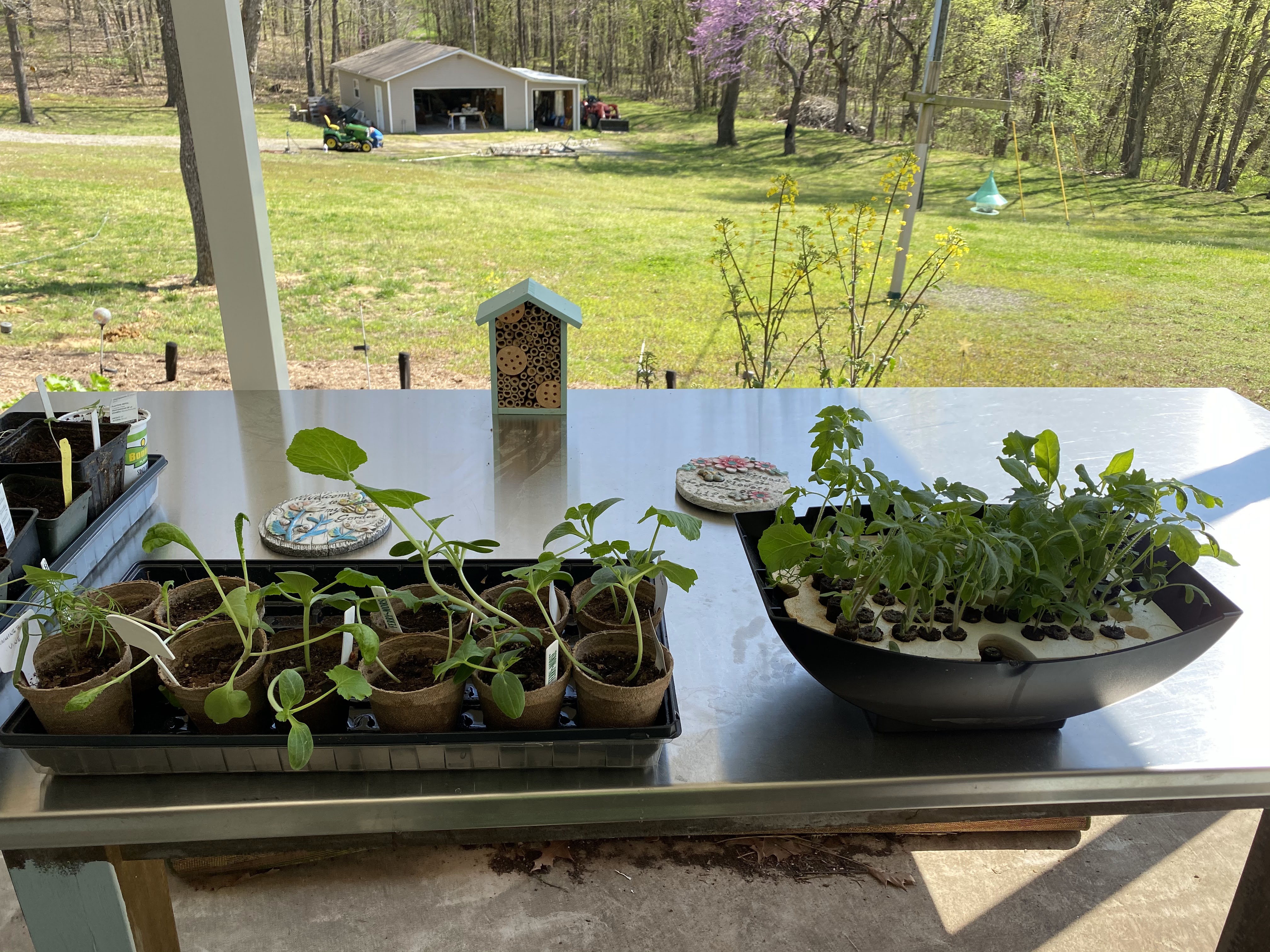
To get a jump on summer harvests, I usually start a variety of edibles indoors on the kitchen counter in both my Aerogarden, peat pods or peat pots.  For the large seedlings like cucumber, squash, and watermelon, I start these in 3" peat pots.  I have had great success in the Aerogarden in germination rates.  It is really close to 100% across all types of seeds.  Seed starting tips for beginners  You can get also get a jump on harvests by buying transplants.  There are a wide variety available nowadays, including heirlooms.
Aerogarden on the right, peat pods on the left
The varieties I like to start indoors: tomatoes, peppers, okra, rosemary, a variety of basils, dill, Alpine strawberries, eggplants, New Zealand spinach, Malabar spinach, blue morning glories, cucumbers, zucchini, spaghetti squash, bulbing fennel, watermelon, pole green beans, and any interesting varieties I just couldn't resist buying seed for over the winter.

Fertilize
When you plant, make sure to fertilize and add mycorrhizae in each planting hole. Mycorrhizae are beneficial microbes that help your plant roots absorb nutrients from the soil.  I also add biochar and worm castings in each hole.  Using these amendments is when I had the most productive and disease free summer gardens.

I like to apply fertilizer, add a thick layer of compost and top with mulch before I even begin planting.  Just mulch by itself breaks down and adds organic matter to the soil.  I use only organic fertilizers and amendments.  There is a great deal of research that shows chemical fertilizers negatively affect the soil food web.  Weed free, self fertilizing, till free garden beds

If you didn't do a soil test (you can use a kit from a garden store/big box store or have your local extensions office analyze it), use a balanced organic fertilizer like Espoma at the rate recommended.  If you regularly use a balanced fertilizer, nitrogen may be the only amendment you need.  

You can make your own all natural, organic fertilizer, too, inexpensively.  Here is the link:  Make your own fertilizer, it's all natural and inexpensive  If you did not fertilize the entire garden bed before planting, be sure to add fertilizer to each planting hole per the directions on the package.  Crops will need that burst of energy for the quick growth that spring brings. 

If you want to have an in-depth soil analysis done to create a fertilizer specific to your soil, here is a blog on who to send your sample to and how to get a personal fertilizer recipe  The next step in garden production and your nutrition-soil minerals

If you are re-using pots from last year, here is a link to get your potting soil ready to nourish your new plants:  Re-energize your potting soil!  It is important to get your potting soil so it can support this season's growth and veggie production.  Be sure when you fertilize to mix it into the soil or apply before you put down a protective organic layer of mulch.  This keeps the nitrogen from oxidizing and escaping into the air instead of staying in the ground to nourish your plant.  To re-energize my potting soil, I add 1 part compost to 2 parts potting soil, Azomite for minerals, and Espoma fertilizer.  
Chives and lettuce in  mid-April garden
Frost date importance
The last frost date in our area is April 2nd this year.  This is important to know for planting seeds and when to move plants into the garden.   Frost date look up  The seed packet tells you when to plant in relation to your last frost date.  You will get the best results following the packet instructions.  Planting early is not always a good strategy as different seeds need different soil temperatures before they will germinate.  Plant too early and they can rot before they have a chance to sprout.  When to plant your veggies

Pots will warm up quicker, but will also chill down faster.  You can put your pots in a sheltered, sunny spot to get a jump on spring growth.  Putting your pots on the south side of the house will provide the maximum warmth.  I love planting greens in a large self-watering pot that I can keep on the patio, making it handy for picking a fresh salad for dinner, and to move to a cooler spot in the hot days of summer.  

When growing veggies in containers, they will require more watering and more liquid fertilizer than if they were in the ground.  In the summer, you may have to water some water lovers every day unless you use self-watering pots.  For more on growing in pots:  Decorative container gardening for edibles  
With the self-watering pots, your watering duties will be greatly reduced.

Lettuce, greens, and herbs do fabulous this month.  It is the time to indulge in daily salads. and smoothies.  Cool temperatures and lots of moisture produce the sweetest greens of the season.  

This year, you may have more time or just want to be sure you can get fresh veggies.  Here is a garden that meets that need, even if you only have a small space, like a flower bed.  Small space survival edible garden 

Saturday, April 1, 2023

What to plant in the April edible garden

Seedlings
Saturday, April 2, 2023

April is a beautiful time of year with the leaves coming on, the grass turning green, the first flowers blooming and lots of plants poking their heads out of the ground.  There are many veggie and fruit seeds and transplants that can be put in the edible garden.  It is still too chilly for most of the summer lovers until the end of the month.  Big box stores, hardware stores, local nurseries, flea markets and farmers markets all have plants right now.  This makes it easy to get your garden going in the spring.  You can find many heirloom fruits and veggies transplants and seeds nowadays.  For the unusual plants, buying on-line from seed companies is the way to go.

In preparation for spring planting, I completed my spring checklist and my garden beds are ready for planting!  Spring garden checklist

I have already started salad greens and snow peas on pots.  What's happening in the late March edible garden

Now, I am looking for what to plant this month.  For us, the date of the last frost is April 2, today.  For some of the warm loving crops, this is the date that you can transplant outdoors or start your seeds outdoors.  I always look at the extended forecast to make sure we are not getting an unusual cold snap coming.  Check your seed packet for the best time to sow the seeds.  I like starting seeds in pots outdoors so they are already acclimated to the temperatures and strength of the sun.

Spring loving transplants are in your neighborhood stores that you can pick up now.  I almost always buy some lettuce and spinach transplants to get more plants to harvest from this time of year.  Quick tip-veggie plants are in stores!

Even though you will see summer lovers like basil, tomatoes and eggplant plants in the store, it is still quite chilly for them in April.  They do much better in the warmer temperatures that come in May. 

Starting seeds indoors is a great option too.  You can grow unusual varieties you may not find in stores.  Being inside let's you keep a very close eye on how they are doing, too.  You just need to make sure they are acclimated for the outdoors before transplanting.  "Hardening off" seedlings

Here is a list of plants and seeds you can put in the April garden: 
April-transplants or seeds into the garden or pot Zone 6/7
Amaranth
Asparagus  All about asparagus
Bee balm (monarda)
Brussels sprouts  Growing Brussel sprouts
Catnip
Celeriac
Dill  
Endive
Horseradish
Leeks
Lemon balm
Lovage
Mustard  Mustard greens
Radicchio
Sage
Strawberries  Back yard strawberries
Thyme
Valerian
Any of the above can also be started indoors and then transplanted outdoors into their permanent garden  spot or pot.

April-start directly in the garden or pot
These edibles do best when started directly in their permanent spot.  Almost all root vegetable do best being directly sown (onions and leeks can be started from seed then transplanted to their permanent spot).  
Beans (snap-bush & pole) at end of April  Growing beans
Corn at end of April  Growing corn
Fruit bushes (bare root or potted)  Fruit for small spaces and pots

April-start indoors for transplanting in early May
Lemon verbena
Summer and winter squash  Everything you need to know to grow squash
Sweet potatoes  Growing sweet potatoes

For tips on starting your seeds in the garden:  Outdoor seed starting tips  I also like to put a pot on our covered deck and start seeds there.  Once they are to a good size, I transplant them into their permanent pot or into the garden bed.  Vegetables you can grow in pots

Thursday, March 30, 2023

Quick update-what seeds have sprouted outdoors

Snow peas in outdoor pot
Thursday, March 31, 2023

I have been busy sowing seeds outdoors this season.  I usually do the indoor seed starting routine but decided to do direct sowing into pots this season to see how this approach goes.  I miss seeing my seedlings every time I walk by inside, but it is fun to go outside every morning and evening to see how things are doing.

Late winter and early spring is the time to sow the spring loving crop seeds outdoors.  Here is when and what I planted and how well the germination has been doing. 

February 14-Took off portable greenhouse cover from overwintering greens.  Started planting seeds in outdoor pots.  Planted snow peas-Avalanche 30" vines, Little Purple Snowpea 24" vine, and Sugar Pod II 28" vine.  Almost all the seeds sprouted in about a week.  They are 4-6" long.

February 20-Planted spinach seeds-Giant Winter and Galilee.  Giant Winter has done well in my garden in the past, lasting into May.  Galilee is new to me and is supposed to be heat tolerant.  It took a couple of weeks for them to sprout.  Have had very good germination.  Just now getting their second set of leaves.

 February 25-Planted lettuce and other greens that are heat tolerant to have salads through summer.  Lettuce-Royal Oak Leaf(4 have sprouted),  Oak Leaf (5 have sprouted), Forellebschluss (0 sprouted), Red Sails (0 sprouted), Lunix (0 sprouted), Butter King (8 sprouted), Bronze Beauty (6 sprouted), Solar Flare (6 sprouted, Grand Rapids (2 sprouted).  Still have some coming up so may not be done yet with germination.  Several varieties have their second set of leaves. 
Sweet mustard greens for salads-Komatsuma Tendergreen (8 sprouted) and Chinese Giant Leaf (12 sprouted).  
Chard-Perpetual Spinach (3 sprouted) and Verde de Taglio (5 sprouted).  Starting to get their second set of leaves.
Orach-Aurora Mixed (3 sprouted)
Chinese cabbage-Hilton, Golden Beauty and Scarlette (almost every seed sprouted).  They all have their second set of leaves for a while now.  These have very large, sweet leaves that you can use either for salads or for wraps.
Herbs-planted several kinds with old seed.  Rosemary, Flat Leaf parsley, chives, dill, sweet basil, cilantro.  Did see what looked like dill sprouts but now they are gone.  I have a vole getting into my pots eating some of my greens.  May be them or some other cause.  May have a parsley seedling with its second set of leaves. Will have to wait for it to grow out some more to be sure.
Lettuce transplants
I also got 6 packs of greens from the hardware store late last week-Iceberg lettuce, Green Romaine lettuce, Red Romaine lettuce, Buttercrunch lettuce and Bonnie Spinach.  I planted them this past week end.  After they have recovered from transplanting, I can start harvesting from them as well as the greens that overwintered and the pea shoots.

      Happy gardening!

Monday, March 27, 2023

Quick tip-veggie plants are in stores!


Monday, March 27, 2023

I looked for vegetable and fruit transplants at the local big box and hardware stores this week.  And they are in!  Head to your neighborhood store to get your spring garden going the easy way.

I like to buy lettuce and spinach 6 packs to accelerate the harvest for spring salads.  The rest of the cool season crops are on the outdoor shelves, too.

If you don't want to take the time to sow seeds, buying transplants is a great way to get your edible garden in place and producing quickly.  I have sown lots of spring greens seeds, but I always pick up some lettuce and spinach transplants to get harvesting even quicker.

If you are a beginner, lettuce is a great crop to start with in the early spring.  It does well in a pot and will produce until it starts getting up in the 80's.  Just harvest the outer leaves and let the inner leaves continue to grow.  It's a perpetual salad producer!  Lettuce is easy to grow.

I also get at least one 6 pack of spinach because it is a power house of nutrition and my husband loves it.  Spinach will "bolt" before lettuce does but produces well while the temperatures stay moderate.  It is as carefree as lettuce to grow.

  If you want to turbo boost your greens production in pots, use a water soluble fertilizer every other week when you water.  Greens love fertilizer!

      Happy gardening!

Sunday, March 26, 2023

Spring garden checklist

Spring garden ready to go!
Sunday, March 26, 2023

March 21st was the official start of spring season!  and April are prime time for cold season crops like greens, cabbage, kale, broccoli, Brussels sprouts, carrots, beets, radishes and cauliflower.  In March, you can direct sow (plant seeds in an outdoor pot or your garden bed), start seeds indoors or transplant plants that you have bought locally or raised indoors.

It is time to take stock of your garden and plan for getting ready for planting.  I plant in pots and in my mulched garden beds.  I find that planting edibles in with my flowers not only looks good but the pollinators the flowers attract improves the harvest.  Mulching keeps weeds to a bare minimum and adds organic matter each year that plants love.
1.  Do a clean up of last year's debris.  I leave the seed heads over winter for the birds to eat.  Come spring, it is time to clean out all the dead debris and fallen leaves that have blown into the garden bed and pots.  Diseases can overwinter in them so it is best to clean the debris out before planting.
2.  Prune/divide perennials, bushes and trees.  Early spring is a great time to prune and divide.  You can see the structures of your bushes and trees clearly this time of year making it easier to decide how to shape them.  As perennials sprout, go ahead and start dividing them.  Re-planting early in the season gives them time to re-establish their roots before the hot, dry summer is here.
3.  Make a list of what you want to plant this year.  I make a list at the end of the growing season in fall on what went well and what did not, what I think I want to plant for the next growing season.  I have added to it with the new seed catalogs and what we took from the pantry and freezer over the winter.  With my final plan in hand, I take a look at what can be planted in pots and what does best in the garden bed.  Edible garden plan for 2023
4.  Layout the plantings for your existing beds and pots.  Verify that you have the space in your garden beds and pots for what you want to grow this season.  If you don't, you will either need to pare back the plan or add more planting space.  How to develop an edible garden plan
5.  Have a soil test done.  A soil test will give you exactly what your garden bed needs to be at peak nutrition for your plants.  If you don't have the time to do a soil test, at least add compost and natural nitrogen to your beds (manures, alfalfa meal, fish meal, bat guano, etc.).  Nitrogen typically needs to be added every year unless you have a nitrogen rich compost.  The next step in garden production and your nutrition-soil minerals
6.  Add amendments like compost and fertilizer, top beds with mulch.  Nitrogen will oxidize with the air so you should cover it with soil or mulch after applying to keep it in the soil and available for your edibles.
7.  Decide on expanding the garden.  If you have more to plant than space, decide if you want to use pots and bags for the extras or creat new beds.  There are many edibles that do great in pots like greens, bush cucumbers and zucchini, pole beans, snow peas, peppers, tomatillos, and eggplant.  Potatoes can be grown in potato bags.  Okra and tomatoes production is significantly reduced unless they are planted in a garden bed.  Vegetables you can grow in pots
8.  Put in new beds, if needed.  For any new beds, the easiest way I have found is to use a garden hose to outline the new bed, apply amendments, cover with cardboard and top with mulch.  The cardboard will smother the grass and weeds.  Plus it attracts earthworms that will loosen the soil will adding fertilizer to the bed.  Mulch keeps it all in place while suppressing weeds and adding organic matter to your beds.  Put in a new garden bed the easy way-really
9.  Verify your planting supplies.  Make sure you have the worm castings, char, fertilizer, and gardening tools you need to sow seeds and plant seedlings.  Get what you are missing.  Quick tip-the few tools needed for edible gardening

Now you are ready to plant!