Thursday, April 11, 2024

Everything to know to grow mustard greens

baby Giant Red Mustard on right in middle

April 11, 2024

Many think of mustard as the yellow condiment you put on burgers and hot dogs.  There are also many varieties of mustard that are grown for their leaves.  Mustard leaves get stronger as the weather gets hotter.  They definitely have a "bite" similar to arugula in summer heat. 


Mustards come in different heights, colors and leave types.  They are a great add to salads, cooked and in cooking.  Mustard greens are chock full of antioxidants, manganese, calcium, potassium, vitamins A, C and K, and folate.  Nutritional info

Giant Red Mustard
Mustard greens can be cultivated in the spring or for fall.  They produce well throughout the summer and overwinter down to 0 F.  Ideal sowing times are March-May for spring/summer harvests and July-August for fall/winter harvests.   They prefer rich soil and should be kept moist until sprouted.  

Sow seeds on the soil, then rake in.  Can be grown in the garden bed or a pot.  Seeds will sprout in 3-4 days.  Harvesting can begin as soon as 10 days.  You can also buy them as bedding plants in the spring.  If you do want mustard seed, they will be ready in 8-10 weeks.  Seeds form after flowering.  In summer months, they appreciate some afternoon shade.

You can basically use as you would arugula.  You can also eat the new leaves in salads or sauté or steam the larger leaves.  You can harvest the outer leaves when they are 3-4” long for cooking or salads.  Store at 32 degrees F and high humidity in the frig for the longest life.

For any that I don't eat fresh, I blanche and freeze to add to a steamed veggie side dish or to soups and roasts.  You do need to blanche mustard and other greens to maintain the taste.  Freezing the extras for winter

My favorite varieties to grow are Giant Red, Ruby Streaks, Golden Streaks and Giant Leaf mustard.  Giant Leaf does have large leaves and stays much sweeter in the summer for salads.  Ruby and Golden Streaks are striking in the garden and salads.
Ruby Streaks and Golden Streaks mustard

Wednesday, April 10, 2024

Everything you need to know to grow asparagus

Sprouting asparagus in spring
Wednesday, April 10, 2024

Asparagus is a spring time treat, and a perennial vegetable as well.  It grows tall in the summer with pretty, lacy foliage   Asparagus came to the States in colonial times.  It dates back to Egyptian times 3000BCE and is thought to have been domesticated by the Moors in Spain.  In the wild, the spears are about the width of a pencil.  The type we enjoy today was developed in the 18th century. 

Asparagus has good nutrition, being low carb with moderate protein, fiber, vitamins A, C and E, iron, folate, riboflavin, and thiamine.  It has 70% of daily recommended vitamin K.   Asparagus nutritional profile  

Asparagus will last in the garden for 15 to 20 years.  Asparagus is a hardy perennial and will survive winters even in Zone 3.  The mature plants will be 4-5 feet tall.  It takes 2-3 years after planting to be able to harvest.  The plant needs time to fully establish its root system.  Establish new plants in spring or fall.  Buying crowns to plant may accelerate your first harvest.  In our Zone 7 garden, now is the time to plant asparagus crowns.

It is the first shoots of the plant that are harvested in spring and eaten.  Once the stem begins to fill out, they become woody and don't taste that great.  Asparagus plants grow quite large so should be planted in rows 6 feet apart.  I use flower rings to support their summer foliage staying upright.  The plants themselves can be planted 1 foot apart in the row.  Asparagus plants have fernlike foliage.  You can either plant them off by themselves or along the back of the garden bed.  Just be sure to have a way to get to them for harvesting and fertilizing in the spring.
Mature asparagus plants
Asparagus prefers a light soil, rich in organic matter that is well drained.  Loosen the soil to 6" deep and mix with organic matter (compost) when planting the original bed.  In subsequent years, apply a top dressing of compost in the winter months. It is best to get the crowns in soil as soon as you get them.  Crowns can be planted 4-6 weeks before last frost (early March for our Zone 7).  It is best to create a small mound to lay the roots out around the mound.  

You can start seeds indoors as early as 60-90 days prior to last frost and transplant seedlings outdoors as soon as danger of frost has passed when daffodils are fading and soil temperature reaches 50 degrees F. 
Baby asparagus plants
April is prime asparagus harvest time.  You harvest the spears when they are 6-10" tall, cutting about an inch above the soil surface.  You can store in the refrigerator for up to 2 weeks.  36 degrees F and 100% humidity are the ideal storage conditions.

The first year of planting, you will not harvest spears.  You can harvest for 2-3 weeks in the second year and 6 weeks the following years.  It is best to leave the smallest spears to help support the roots and leaves of the plant to give stronger harvests year after year.  Fertilize early in spring and again after harvest each year.

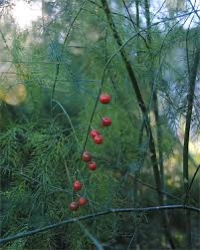
It is the male plant that produces the larger, thicker spears whereas the female plants produce small berries (seeds).  Each asparagus plant is dioecious, meaning they are both male and female.  That is why you will see in the description of the variety what percentage of the plants will be female and what percentage will be male.  To have a productive asparagus bed, remove the female plants.  Be sure to take this into account when you plant your bed as you will need to plant more than you will end up leaving in the garden.
Berries on female plants
Pests of asparagus are the asparagus beetle and slugs.  You can use pyrethrin for the beetles and slug traps or baits to keep the slugs under control.  I recently saw wool pellets that you sprinkle around your plants that are susceptible to slugs and the pellets will expand into woolly balls that slugs won't cross so that is another option.

Not planting next to alliums, potatoes and corn can reduce the number of pests attracted to your asparagus.  Alliums exude chemicals in their roots that can stunt the growth of asparagus.  Good companion plants for asparagus includes tomatoes, parsley, nasturtiums and marigolds as they repel pests and basil as an attractor of predatory insects that eat pests.

Asparagus is susceptible to fusarium wilt and stem, crown rot, and rust.  This is why it is important for them to be in loose soil that is well drained.  If your garden conditions aren't ideal, be sure to look for varieties that are resistant to these diseases.

Tuesday, April 9, 2024

Grow a carefree allium-chives

Common chives in bloom in spring
Tuesday, April 9, 2024

Chives are a perennial herb that comes back year after year.  They are great to use in salads or as a topping on just about any dish.  You can grow from seed or buy a plant at your neighborhood big box store or nursery.  They are a carefree herb with pretty flowers.

Chives are part of the onion family, an allium, so has all the great health benefits of onions.  Chives and onions have traditionally been used as an antibacterial, cancer preventer, cancer fighter, and even for its sore throat properties.  Recent studies have confirmed the medicinal properties.

Chives originated in Asia and were first eaten by the Chinese.  Chives have been used for over 5000 years.  Early American colonists brought chives with them to start in their new gardens.

Chives will grow 18-24" tall.  There is the common chive and also the garlic chives.  The common chive has an onion flavor and, as it name suggests, the garlic chive has a nice garlic flavor.  The common chive has tubular leaves and pretty lavender spring flowers.  Garlic chives have flat leaves and pretty white flowers in the fall.  

To use, just snip an inch or two above the ground and use fresh.  I have tried using chives in cooked dishes and they just become woody.  Go ahead and garnish the cooked dish with fresh chives.  Not only looks pretty, but adds nice flavor.
Garlic chives in bloom in the fall
Chives are super easy to grow.  I think the easiest thing to do is buy a plant in the spring.  Since they come back year after year, you only have to buy one plant for your garden.  Just plant and watch it grow.   Every few years, if it is super happy with its spot in the garden, it may need to be divided to keep it vigorous.

The only watch out with chives I have seen is that the garlic chives are super self-seeders.  If you don't remove their flowers when they start to dry, you will have lots and lots of new little chive plants!  You can either just snip the flowers off when they start to dry or snip them when they are fresh and use as you would the green leaves.  The flowers tend to have a stronger flavor than the leaves. 

Monday, April 8, 2024

Grow nutritious collards and kale

Potted kale, petunias and Egyptian walking onions
Monday, April 8, 2024

Kale is not only beautiful, it is good for you!  Kale is chock full of antioxidants, beta carotene, lutein, vitamins C and K, and calcium.  It also contains compounds that are potent against cancer, sulforaphane and indole-3-carbinol.  kale nutritional info  Collards are a great source of vitamins A, C, K and folate.  collards nutrition
Kale was the first to be domesticated from the ancient cabbage family of plants.  The Celts were the first to cultivate these greens, causing the birth of kale, broccoli, cabbage, collards, cauliflower, brussels sprouts and kohlrabi.  Thomas Jefferson’s favorite kale was a variety similar to a Siberian kale.  He also grew a variety similar to today's Tuscan kale, also known as dinosaur or black kale; a very striking plant to have in the garden with its long, dark blue-green and bumpy leaves.

Collards are a uniquely American vegetable that has always been associated with the South and appeared in the late 1700’s.  

Most kale and collards are biennial, but there are still perennial varieties if you can find the seed.  Perennial varieties include tree collards, walking stick kale, western front kale, Dorbenton kale, and sea kale.  

Dwarf blue curled kale
If you want to save seed from the biennial, you have to allow the plant to go through one winter, allow to flower and dry on the plant.  Kales cross easily with other kales and collards so if you want true to type, grow only that kind in your garden.  Flowering kale have pretty yellow flowers and the bees love them!

There are many colors and textures of kales.  There are the “dinosaur” kales which have a blistered, black appearance, red kales, green kales, dwarf kales, green, red kales, and ornamental kales which are edible.  Some are more winter hardy than others.  Check seed packets for descriptors like "winter hardy" and "cold tolerant".  Those grown in the fall are sweetest if picked after a frost.  Fall garden planning and planting

Kale is generally a fall crop but can be cultivated in the spring.  Collards are typically planted in the spring in colder climes and can be planted in the fall in warm winter regions.  They can be started indoors or direct seeded in May (soil temp of 55-75 degrees F).  They prefer rich soil and should be kept moist until sprouted.  Sow seeds 1/4” deep and 4-6” apart, thin to 12”.  If planting rows, allow at least 18”.  I have also had great success raising them in a pot. 

Several varieties of kale come available as bedding plants in late March.  Since we live in Kentucky, there are always collards as well.  Both can be planted into beds and pots in our Zone 7 garden now.

For fall, plant around Independence Day (July 4th).  Kale can be grown in garden beds or pots.  It is very cold hardy and survives through most winters. 

You can harvest the outer leaves when they are 8-10” long for cooking or juicing.  You can also harvest the leaves when smaller for salads.  Store at 32 degrees and high humidity in the frig for the longest life.

One of the fun ways to prepare kale is to salt and dry in a dehydrator or low temp in the oven.  They can be eaten as you do chips, but are much healthier.  You can also eat the new leaves in salads or sauté or steam the larger leaves.  Dehydrate or sun dry your extra veggies

For any that I don't eat fresh, I blanche and freeze to add to a steamed veggie side dish or to soups.  You do need to blanche kale and other greens to maintain the tasted.  Freezing the extras for winter 

Sunday, April 7, 2024

Everything to know to grow turnips

Purple top turnips
Sunday, April 7, 2024

Turnips are rich in folic acid, iron, vitamin C, fiber, vitamin B6, vitamin A, vitamin K, potassium, and magnesium.  Antioxidants like those in turnips protect against heart disease and cancer.    Nutritional info

The greens themselves are also edible and are an excellent addition to spring and fall salads.  We also like our turnips steamed or grilled.  This brings out the starches of the root, greatly reducing any bitterness.  You can also grow golden turnips which are much sweeter than the traditional turnips your grandparents grew. 

Turnips are the most ancient of roots, haling from the Far East (Afghanistan/Mediterranean basin area).  They were first domesticated in 15th century BC in India.  Turnips were used as livestock feed, growing to 30-40 pounds in the 1500’s in Canada.  By the 1700‘s, turnips were the most important root crop for both people and cattle.  The purple top turnips we are familiar with today also arose in the 1700’s.

Turnips are biennials that have to overwinter to flower and produce seeds.  The seed stalks are quite tall, reaching 3 feet in height.  If you want to allow your turnips to flower and save seed, staking is needed.

Turnips can be sown in spring or fall.  The sweetest and largest roots will be from fall sown.  Sow when the daffodils are in full bloom in spring and when goldenrod blooms in fall.

Turnips are easy to grow and prefer sandy, loose soil.  The flavor is best when grown in poor soil.  Maintain evenly moist soil; dry soil will produce woody cores.  Plant 1/2” deep and thin to 4” apart.  Space 18” from next row of crops.

Harvest leaves when they are 4-6” high.  Only pick a third of the leaves if you are planning on also eating the root.  Roots should be pulled when 3” in diameter; they are the sweetest after a frost.  When pulled, you can also add the greens to your salad.

For any extras that I don't eat fresh from the garden, I like to blanch and freeze the rest.  I add turnips to a mix of other frozen garden veggies for steamed veggies.  A great way to preserve your garden bounty and get a super nutritious side dish.  For more on blanching, Freezing the extras for winter

Saturday, April 6, 2024

April 2024 Edible Garden Planner

April edible garden
Saturday, April 6, 2024

April showers bring May flowers, fruits, herbs and vegetables!  Now is the perfect time to get serious on getting your spring garden planted and sown.  In April, I usually have seeds and plants going indoors and outdoors.  With all the selections they have at nurseries and big box stores, it is easy to skip this altogether and just buy plants you to have an instant garden!

Crops to plant in April
Early April is a perfect time to plant cold season crops like Brussels sprouts, fava beans, beets, broccoli, cabbage, carrots, cauliflower, celery, collards, kale, lettuce, mustard, onions, parsley, parsnips, peas, potatoes, radishes, shallots, spinach, strawberries, Swiss chard and turnips.  Local big box and nurseries have a variety available to put in your garden right now.  Outdoor transplant calendar

See this post for what to plant in April as well as links on how to grow each veggie.  What to plant in the April edible garden

We have fresh salads from the garden now.  The greens that overwintered are sprouting broccoli, cress,  chickweed, sorrel, and cultivated dandelions.  The other herbs that overwintered are celery, carrots, chives, Egyptian walking onions, oregano, tarragon, sage, and thyme.  They are great adds to salads as well as cooked dishes.

There are many volunteers sprouting from giant mustard, lettuce, celery and cilantro.  These are the cool temperature lovers.  Next month, the warm season loving volunteer veggies and flowers will be sprouting.

We can still get a surprise frost in April so you want to hold off on planting warm season crops outdoors like tomatoes, eggplant, peppers, beans and squash until May unless you cover them or can bring them indoors if frost does visit your garden.  Warm season lovers won't grow much at all anyway until the soil is nice and warm.  I usually start and move them outdoors in May for our Zone 7 garden.  If you want to see how early you can go, try using protection to keep them warm.  Extend the season with protection for plants

I have already transplanted lettuce and spinach plants outdoors.  I have them in pots in my walk in, portable greenhouse.  I moved them outdoors last week. The extra warmth helped them grow quicker, but is not needed for the plants to survive this time of year.   

To keep yourself in lettuce all season, do succession planting of new seeds or plants every 2-3 weeks.  Just plant the number you would normally eat in a 2-3 week period.  This will keep salads on the table continuously.  Do succession planting for any vegetable you want to extend the harvest for.  Keep the harvest going, do succession planting

If this is your first year in gardening, here are some pointers on what to choose to grow and get your garden going: What to plant for your first garden  Easy kitchen garden   If you don't have much space you can still grow a garden either in pots or in a garden spot as little as 6" by 6' that can grow all the produce you can eat during the garden season. 

To get a jump on summer harvests, I usually start a variety of edibles indoors on the kitchen counter in both my Aerogarden, peat pods or peat pots.  For the large seedlings like cucumber, squash, and watermelon, I start these in 3" peat pots.  I have had great success in the Aerogarden in germination rates.  It is really close to 100% across all types of seeds.  Seed starting tips for beginners  You can get also get a jump on harvests by buying transplants.  There are a wide variety available nowadays, including heirlooms.
Aerogarden on the right, peat pods on the left
The varieties I like to start indoors: tomatoes, peppers, okra, rosemary, a variety of basils, dill, Alpine strawberries, eggplants, New Zealand spinach, Malabar spinach, blue morning glories, cucumbers, zucchini, spaghetti squash, watermelon, pole green beans, and any interesting varieties I just couldn't resist buying seed for over the winter.

Fertilize
When you plant, make sure to fertilize and add mycorrhizae in each planting hole. Mycorrhizae are beneficial microbes that help your plant roots absorb nutrients from the soil.  I also add biochar and worm castings in each hole.  Using these amendments is when I had the most productive and disease free summer gardens.

I like to apply fertilizer, add a thick layer of compost and top with mulch before I even begin planting.  Just mulch by itself breaks down and adds organic matter to the soil.  I use only organic fertilizers and amendments.  There is a great deal of research that shows chemical fertilizers negatively affect the soil food web.  Mulch also does a great job of suppressing weeds.  Weed free, self fertilizing, till free garden beds

If you didn't do a soil test (you can use a kit from a garden store/big box store or have your local extension office analyze it), use a balanced organic fertilizer like Espoma at the rate recommended.  If you regularly use a balanced fertilizer, nitrogen may be the only amendment you need.  

You can make your own all natural, organic fertilizer, too, inexpensively.  Here is the link:  Make your own fertilizer, it's all natural and inexpensive  If you did not fertilize the entire garden bed before planting, be sure to add fertilizer to each planting hole per the directions on the package.  Crops will need that burst of energy for the quick growth that spring brings. 

If you are re-using pots from last year, here is a link to get your potting soil ready to nourish your new plants:  Re-energize your potting soil!  It is important to get your potting soil so it can support this season's growth and veggie production.  Be sure when you fertilize to mix it into the soil or apply before you put down a protective organic layer of mulch.  This keeps the nitrogen from oxidizing and escaping into the air instead of staying in the ground to nourish your plant.  To re-energize my potting soil, I add 1 part compost to 2 parts potting soil, Azomite for minerals, and Espoma fertilizer.  
Chives and lettuce in  mid-April garden
Frost date importance
The average last frost date in our area was April 2nd this year, but some in the area got frost this morning.  This is important to know for planting seeds and when to move plants into the garden.   Frost date look up  The seed packet tells you when to plant in relation to your last frost date.  You will get the best results following the packet instructions.  Planting early is not always a good strategy as different seeds need different soil temperatures before they will germinate.  Plant too early and the seed can rot before they have a chance to sprout.  When to plant your veggies

Pots will warm up quicker, but will also chill down faster.  You can put your pots in a sheltered, sunny spot to get a jump on spring growth.  Putting your pots on the south side of the house will provide the maximum warmth.  I love planting greens in a large self-watering pot that I can keep on the patio, making it handy for picking a fresh salad for dinner, and to move to a cooler spot in the hot days of summer.  

When growing veggies in containers, they will require more watering and more liquid fertilizer than if they were in the ground.  In the summer, you may have to water some water lovers every day unless you use self-watering pots.  For more on growing in pots:  Decorative container gardening for edibles  
With the self-watering pots, your watering duties will be greatly reduced.

Lettuce, greens, and herbs do fabulous this month.  It is the time to indulge in daily salads. and smoothies.  Cool temperatures and lots of moisture produce the sweetest greens of the season.  

This year, you may have more time or just want to be sure you can get fresh veggies.  Here is a garden that meets that need, even if you only have a small space, like a flower bed.  Small space survival edible garden 

Sunday, March 31, 2024

What's happening in the late March edible garden

Daffodils and hyacinth blooming, daylilies sprouting
Sunday, March 31, 2024

Spring in our garden came 2 weeks earlier this year with unseasonably warm temperatures.  Daffodils, hyacinths and Bradford pear trees are winding down their show.  Forsythias, redbuds and lilacs are in bloom.  Peonies are full of buds.  Dogwoods are just beginning to flower.  Spinach and snow peas are growing nicely from seed.   

When forsythias bloom, it is time to apply corn gluten for weed suppression in the garden and yard.  Corn gluten keeps seeds from sprouting and provides nitrogen.  It will also keep grass seed or garden seed from sprouting so use only where you don't want seeds to come up.

In the edible garden, onions, tarragon, garlic chives, mountain mint, asparagus, shallots, garlic and spearmint are all popping up in the garden bed and pots.  Overwintering arugula, carrots, celery, winter cress, strawberry plants, raspberry plants, blackberry bushes, sprouting broccoli, thyme and oregano are growing again.  Chickweed is flowering and growing vigorously.  The garden is giving greens for fresh picked salads.

I have been sowing cold season crop seeds outdoors for a while now.  I started in February with snow peas and spinach in pots in the portable greenhouse (they're about 6" now).  I could start using the pea shoots and spinach leaves for salads.  Peas and potatoes can be planted as soon as the soil can be worked in the spring.

In late February, it was quite warm.  I planted Oriental Giant Winter, Spiros and Galilee spinach and Dragon's Tail radish in pots.  Giant Winter does well in cool weather and gives very big leaves.  All have sprouted and are growing well.

Last week, I transplanted lettuce I bought at the big box store in pots outside.  I have Buttercrunch, green Romaine and Red Romaine growing.  Buying plants will speed up the harvest date.  Should be able to start using leaves in a couple of weeks.

I have started other lettuce indoors that are heat resistant like Lunix, Solar Flare, Bronze Beauty, Royal Oak Leaf, Red Sails, Yedikule and Butter King.  Also started other summer salad greens in my Aerogarden system: Chinese pink celery, Hilton cabbage, Barese Swiss Chard, Japanese Mountain Spinach (a Swiss Chard), Chijimisai Greens, Molten Fire Amaranth, Pink Beauty Amaranth, Big Leaf Tong Ho, Aurora mixed colors orach.  They are all ready to transplant into bigger pots and harden off.

I did a round of herbs, too, in the Aerogarden.  Planting rosemary, flat leaf parsley, curly parsley, dill, sweet basil, cardinal basil, blue spice basil, sage, salad burnet, and cilantro.  They are not yet big enough to transplant into bigger pots.

Last year, we got our mulching done early in March.  Early March is an ideal time to mulch.  It's before the self-seeders are sprouting and it adds warmth to soil.  It looks like we won't be mulching until April this year.  

I had a soil test done in the fall that shows my soil is getting on the high side for alkalinity (pH 7.8) and needed nitrogen and a minor amount of potash.  I will add sulfur to lower the pH into the range preferred by most edibles, 6-7, and add nitrogen and potash right before mulching.  I will put a thin layer of compost and then top it all with mulch.  It is best to either dig in your nitrogen fertilizer or cover it soon after you spread it.  If not, the nitrogen reacts with the oxygen in the air and doesn't stay in the soil.

For growing edibles, you can count on needing at least nitrogen addition unless you are doing nitrogen fixing cover crops.  I have tried a few different all natural nitrogen fertilizers.  Kelp adds a variety of minerals plus it has growth hormones in it so is a great choice for plants you want a lot of height for.  Many of the organic fertilizers use chicken manure as a main component.  We have chickens so I compost their bedding to use in the garden.  I use alfalfa meal which is a good source of nitrogen for planting and adding to my greens during the growing season.

If you are creating new beds, put down cardboard first before fertilizing and mulching.  This added layer will keep the grass and weeds smothered while attracting earthworms.  Earthworms love cardboard!  They not only loosen the soil, but also fertilize it.  A real win-win. 

If you don't have a lot of time this year, transplants are always a great option.  Cool season crop transplants are at the local nurseries and big box stores now.  They have broccoli, cauliflower, cabbage, onion sets, lettuce, strawberries, potato sets, boxed dormant fruit bushes and trees.  The rest of the cool season transplants will be coming in over the next couple of weeks.  It's time to buy what you want for your spring garden and transplant!  
Overwintering cabbage and broccoli
I'll be buying lettuce and spinach to supplement what overwintered and what I have already sown.  I won't need more than a couple 6 packs with everything I have already sown.  

The big box stores some herb transplants and more will be arriving.  The ones that can be planted now are thyme, sage, garlic, parsley, and celery.  I'd hold off on the rosemary and especially the basil.  If it gets even close to freezing, basil can be killed in the garden.  You can buy and keep them in a sunny window in the garage and they should be fine.

Tomatoes in the store, too.  I'd wait on those.  Tomatoes, peppers and eggplant all need warm days and warm soil to thrive.  A freeze can kill them.  I usually wait until May to plant these summer lovers.