Sunday, November 27, 2016

What's happening in the late November edible garden

Potted lettuce
Sunday, November 27, 2016

Well, the first hard freeze has finally swept through the Midwest.  It was a record high temperature and record low rainfall for our fall season, but the summer veggies are now done until next spring.  Does that mean the end of the kitchen garden?  Nope.  There is still much in the garden to enjoy!

I brought in the last of the peppers, tomatoes and eggplants a couple of days ago.  I'll let them ripen on the counter.  For tomatoes, it is recommended that you wrap in newspaper and store in a dark place for ripening.  A late fall tradition-fried green tomatoes!  For unripe fruits, make sure you check for any soft spots that signal frost or freeze damage.  These tomatoes, peppers and eggplant will rot.  Add them to your compost.

The cold season crops have survived the first twenties of the year.  Kale, lettuce, broccoli, onions, mustards, chard, and herbs are nice and green.  All cold season crops get sweeter when the mercury dips.

It is time, if you haven’t done so already, to pull up the old vines and give them to the compost heap.  Only compost those that were free from disease; you don’t want to re-introduce any diseases to your garden next season.  Composting is possible in small spaces or even indoors

If you are gardening in pots, move them up against a wall that gets southern exposure.  This will move your effective climate zone up a full zone.  If they are on stands or coaster, set them onto the ground.  They will stay much warmer on the ground than suspended off the ground.  Homegrown, organic salads in a Midwest winter

Now is a fun time of year to experiment in the kitchen with all the fresh herbs that are available.  Parsley, thyme, rosemary, sage, tarragon, bay, lavender, chives are all hardy herbs in November.  I have had many Christmas dinners with herbs fresh from the garden.  Jazz up the Christmas feast with herbs from the garden

Potted celery

You can also take a look at all the tomatoes you have put up in freezer bags.  If you have more than you know you need, this is the perfect time of year to do some water bath canning.  Time to make homemade tomato sauce!

As even more freezing weather comes our way, you can extend the season for lettuce and greens through the winter by using a portable green house or making your own hoop house.  It doesn't work just for spring, but also for fall and winter!  Extend the season with protection for plants

The biggest killer of veggies in greenhouses?  Getting too hot!  Make sure you crack open your green house when the temps get above freezing and the sun is shining.  

I have a little portable green house I put over my Earthboxes.  I will still have lettuce until spring.

Sunday, November 20, 2016

Time to make homemade tomato sauce!

Sauce in Weck canning jars
Sunday, November 20, 2016

Every fall, I take all the frozen tomatoes from the previous year and make it into homemade tomato sauce.  I wait until it is nice and chilly outside so all the heat and humidity feels nice inside.  This week end is the sauce making day!  It is just in time because I used my last jar for chili and it is supposed to have a high in the 40's.  Perfect sauce making weather.

When I freeze my extra tomatoes during the summer, I always label the freezer bag with the contents and date.  Tomatoes keep for a good year in the freezer.  For any that we do not make into salsa or use in other recipes from the previous year, I use to make sauce.  
Only a water bath is needed for canning tomatoes because they are acidic.  Make sure you follow the sauce canning recipe exactly as it is critical for keeping the right acid level so your sauce doesn't spoil.

I use Weck's canning jars.  They are all glass so there are no worries about the lining of the lids.  And they are a really pretty shape.  These are made in Germany.  I have also found all glass jars made in Italy as well.  None yet made in the USA unless you get antique jars. 

All you need to can tomato sauce is a large pot, canning jars, a metal funnel and tongs.  A pressure cooker is not needed for acidic tomato canning.  For more info on canning, see  Easy, low tox canning of summer's bounty
All glass canning options
Some remove the skins and seeds from their sauce.  I just throw the entire tomato into the food processor and use it all to make our sauce.  Some say you can get a bitter flavor if you include the seeds and skins.  That has been my experience.  Besides seeds are chock full of nutrition.  I also use all types of tomatoes to make sauce, not just paste tomatoes.  Paste tomatoes are not as juicy so it does take longer to cook down, but all tomatoes taste great in sauce!

I do the same thing with the extra sweet peppers frozen from the previous year.  I used them in the sauce, too.  Everything I put in our sauce is homegrown from our garden, except the lemon juice.  We are too far north for lemon trees!  

Here is the recipe from Ball’s “Complete Book of Home Preserving” for tomato paste:
9 cups of pureed tomatoes, 1½ cups of chopped sweet bell peppers, 2 bay leaves, 1 teas salt, 1 clove of garlic.  I'll also toss in some of my dried mixed herbs for flavor.  About a tablespoon or two per batch.

I put it all into a large pot and let simmer until it is the consistency and taste I like, about 2.5 hours.  Remove the bay leaves and garlic.  Boil the jars, lids, and seals as the sauce is close to done.
Tomatoes sliced and in quart freezer bag
Add 3 teas of lemon juice to each hot pint jar, fill with the hot tomato sauce to within ½ inch of the top, and seal the lid, following the instructions for the type of jar you are using.  Place all the filled jars in a large pot, insuring they are fully covered with water.  Bring to a boil and process for 45 minutes.  Remove from canner.  Let cool.  Test the seal after the jar is completely cool.  It should not lift off.  That’s it!  

Last year, I canned 12 quarts of frozen tomatoes yesterday and this gave me 1 gallon (4 liters) of sauce.  I use the half liter Weck's tulip jars which is almost the exact size of a pint jar. 

Other high acid foods you can using a water bath are jams, jellies, condiments, salsas, pickles, and relishes.  Consult with a canning book for more tips and always be sure to follow the recipe exactly to ensure they safely keep.

Saturday, November 19, 2016

Use this winter to figure out what to grow in the spring!


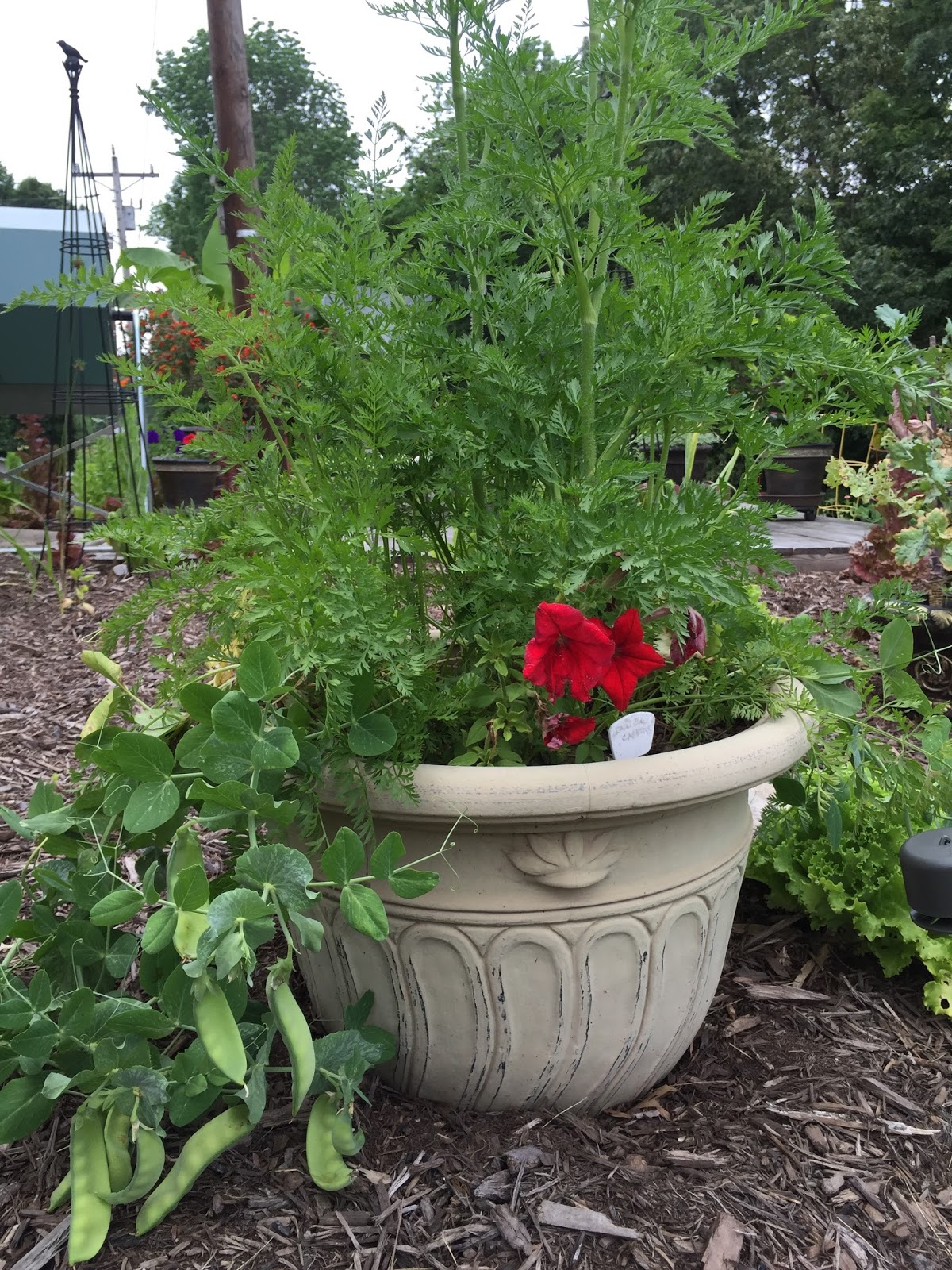
Carrots, snow peas, and petunias in a pot
Saturday, November 19, 2016

If you are thinking of starting a garden next spring, fall and winter are a great time to track what fruit and veggies you eat.  You should grow what you love to eat!  Keeping track of what you buy each week will give you a great list of what to plant in your first garden.

You can use a spiral notebook or an electronic spreadsheet.  Just put in a tick mark under your favorite fruit or veggie heading every time you buy it at the store.  Then, in the spring, you know what you want to grow and how much of it to grow.

This table gives you the number of plants or seeds you need per pounds of produce you want to get from your garden:  Chart for how many to plant

If you want a rule of thumb based on your family size and don’t want to track exactly what you have purchased, just use the table for how much to grow per person in your household as a rule of thumb.  You can adjust after the gardening season is over.

There are also many programs and app’s out there today that can help you know what to grow, when to plant, and will give you growing tips on each fruit or vegetable.

The biggest watch out for starting a new garden is starting too big.  Start small with what you use the most in the kitchen.  Herbs, lettuce, carrots, radishes, peppers, or tomatoes are great ones to start with.  Here is a recommendation for a first garden to modify for what you love to eat:  What to plant for your first garden

Saturday, November 12, 2016

Edible garden winter checklist


Saturday, November 12, 2016

When a hard freeze is in the forecast, it is time to pick the last of the tomatoes, peppers and eggplants and clean the plants from the garden and give your cold crops a coat to protect them all winter!

Last Harvest
When a hard freeze is in the forecast, it is time to pick the last of the summer veggies and winter squash.  Any cold sensitive edibles should either be picked, covered or brought indoors.  Tomatoes, peppers, eggplant, basil, summer squash like zucchini, and cucumbers are all freeze sensitive.  You can also take tender ends from basil to root them to grow indoors for the winter if you have a bright window to place your plant.

Peppers, eggplant, and tomatoes will do well indoors.  They will continue to flower and fruit for weeks.  Their flowers and fruits are pretty, too.  Come spring, they will have a one to two month head start on the season.

Tidy Beds & Compost
It is time to clean up your edible garden to prepare it for the long cold season.  You can compost any that were disease free, but dispose af any diseased plants in the garbage.  Only high sustained temperatures will destroy the spores and it is not worth the risk of spreading disease into next year’s garden.

New Beds & Soil Sampling
Now is the time to lay out any expansion you want to do in your garden beds.  Using a hose to outline the new beds is a great way to envision how they will look.  You can simply cover with card board to kill the grass over the winter.  I like to cover with cardboard, add a layer of compost and fertilizer, then top with mulch.  Letting the bed lay over the winter will allow the fertilizer to seep into the soil so it is ready to plant come spring.  Take a soil sample from your new bed(s) and existing beds to take it in to your conservation office or mail in to a soil analysis service.  The results will tell you exactly what your soil needs for amendments.
Cover Winter Crops
This is the time of year to put a coat over your potted plants left outdoors planted with cold crops.  The best place to locate your plants and greenhouse is close to protection and on the south side of the house in full sun.  Putting the greenhouse against the house will help keep the temperatures warmer for your plants.

I have my mini portable greenhouse over my three Earthoxes that contain kale, celery, French dandelion, spinach, lettuce, blood veined sorrel, and garden purslane.  I also put inside the greenhouse along the outside edge, 5 gallon jugs filled with water and spray painted black.  These will help moderate the temperature inside the greenhouse.

The biggest risk with a greenhouse?  Overheating!  The sun’s rays are quite hot on a cloudless day.  I open the vent on my greenhouse when it is sunny and in the 30’s.  I will unzip the front door flap when it gets into the 40’s.   In the 50’s, the cold crops really don’t need any protection.

Save Seeds
I am going to do a tour of the garden and save seeds from the late producers.  On my hit list is the green beans I left on the vine to keep for seed, flower seeds from the marigolds, hummingbird vine, moon flower vine, and zinnias, and any of the really nice summer vegetable specimens.  It is good to save the best of the best for seed as these parents will give you the characteristics you want in your veggies for next year's garden.

Tool Care
Now is the time to take care of your tools to get them ready and stored for next season.  Sharpen your garden knives, scissors, shovels, and hoes.  Lightly oil all needed to protect from rust and keep working smoothly.  Make a list of any additions you want for your tool collection so you can research and purchase over the winter.

Winter Cover Crops
If you have an un-mulched garden bed, winter cover crops are a great way to protect the soil, keep it from washing and add nutrients your garden needs.

Summarize & Plan for Next Year's Garden
Now is the time to write down all you liked about the garden to you can repeat it for next season as well as what didn't go so well.  You can use the winter season to research solutions to the improvements you want to make on your garden for next year.

I like to look back through all my garden notes for the season and capture the varieties I want to be sure to have in the garden for next year as well as any new ones I want to try.  

For instance, I have been trying different varieties of sweet peppers to see if I can find varieties that are prolific producers in my garden.  I'll write down that I want to search for new varieties to try for next year.  This year I finally found a couple that did well that I want to overwinter this year for next year or start from seed next spring.  I also want to add two of the peppers I saw in Sicily while on vacation with my mom.

Tomatoes-definitely going to put the heirloom Italian paste in the garden, Cherokee Purple, the volunteer that comes back every year, and a couple varieties from last summer's garden-the small chocolate and small black tomatoes.  I also want to try the overwintering varieties that I saw in Sicily.

For eggplant, the Japanese White Egg did really well in the pot, but they were just smaller than I liked.  I'll go back to the white eggplant seed from Martha Stewart collection, the Turkish Orange that I grew last summer in a pot, and am going to try to overwinter my friend's purple potted eggplant that did great this summer.

The cucumber varieties I tried this summer did really well.  I will do them again next year, but stagger their planting as there were just too many of them at once.  Staggering will let the production stay consistent.  As one vine winds down, the next one will be ramping up.  Not sure I will actually do the Hmong again.  It was a great producer, but the fruits were just too large for what I use them for.  Leaning towards planting Dragon's White Egg and Miniature White; perhaps the Jaune Dickfleishige.

Zucchini was a little challenging this year to get the plants going because of all the rain we had this summer.  I am going to look back at what grew well in the garden a couple of seasons ago and replant those next year.  I start these from seed.  I planted Black Beauty, Bush, and Early Prolific Straight Neck which are favorites of many.

All the green bean varieties did great this year.  I am saving the seed from them right now to plant for next year.  Legumes-peas for spring, beans for summer

Spring lettuce-I really liked the Red Romaine and Red Sails lettuce we had in our garden last year.  They stayed a long time before bolting.  I also like the oak leaf lettuces and Grand Rapids varieties.  I'll have all of these in the garden next year.

I'll absolutely do the Cardinal Basil and traditional sweet basil.  I like the Cardinal Basil because it's flowers is just so pretty.  The sweet basil for making pesto.

My husband loves zinnias and marigolds.  I'll start these from seed I save now to grow again next year.  Flowers add not only beauty but attract pollinators.  These little hard working gardener assistants significantly boost your garden fruit production like tomatoes, peppers, beans and eggplants.

Sunday, November 6, 2016

The early November edible garden

Fall garden, very dry this year.....
Sunday, November 6, 2016

Well, we still have not had a hard frost in our Zone 6/7 garden.  We also haven't gotten a rain in weeks and none in the forecast for the next two weeks.  The basil, herbs, eggplant and peppers are still going strong.  The tomatoes and cucumbers have really slowed down.  The Cherokee Purple tomato plant is still going really strong.  

Many of the lettuce I planted in September has bolted, but a few have not.  Everything you need to know about growing lettuce  Be sure to give your fall lettuce a sunny spot and plenty of moisture.  This has been a crazy hot fall.  the hottest September and October on record.  Good for the summer veggies, but has caused many of the lettuce plants to bolt.  The arugula, cultivated dandelions, corn salad, parsley and celery are all doing very well.  The celery is still going strong.  Our celery doesn’t seem to be affected by heat or cold.  We harvest from it year round.  Give celery a try, an easy to grow garden staple

The basil is still growing and has many flowers.  I have left it to flower for the bees, butterflies and other pollinators.  Basil basics-harvesting, preserving, growing basil  The onions are still doing well, both in the garden and pot.  Onions-everything you need to know to grow 'em  The sprouting broccoli plants would really like some cooler temperatures.  I love growing it.  It gives salad greens year round.  Sprouting broccoli- a year round fav

I let the carrots go to flower this summer.  Carrots are in the same family as Queen Ann's Lace and have pretty flowers.  I now have a whole herd of volunteer carrot plants sprouting all over the garden.  You can pull carrots all winter from the garden.  A good frost/freeze really sweetens the taste.  Grow crunchy, colorful carrots practically year round

The next time the forecast has the temperatures going into the 20’s, I will harvest all the peppers, tomatoes, and eggplant fruits and call it a season for these summer veggies.

Potted fall lettuce

You could bring the peppers indoors and they will continue fruiting for weeks and put them back out in the spring to get a head start on summer.  I am going to bring in the best producers of Tangerine Gem and Pimento pepper plants as well as the two ancient pepper varieties I have growing.  I think I am going to let the White Egg eggplant go as the fruits were just so small and try Turkish Orange again next season.  It was a good producer and I really liked the flavor.  

You could also put the potted tomatoes, eggplant and peppers in a greenhouse and lengthen the season for at least another 4 weeks.  

The rest of the herbs are doing very well-thyme, savory, oregano, chives, tarragon, rosemary, sage, bay, parsley, lavender, mint.  You can still harvest your herbs for drying to use all winter.  Make your own "Herbes de Provence"

Don't forget your local Farmers Market if you want local and freshest produce in season.  Many are open all winter long!

Sunday, October 30, 2016

What's growing in the late October garden

Fall garden

Sunday, October 30, 2016

Well, we had our first frost over a week ago in our Zone 6 garden.  The temperature got down to 36 degrees F.  It wasn't quite cold enough to hart the summer veggies like tomatoes, peppers, or eggplants.  The shorter days are causing them to slow down in production, though.  

The pepper plants are still going strong.  The tomatoes, eggplant, and cucumber have really slowed down.  The basil and other herbs are enjoying the temps and sun we have been having.

The basil will be the first to let you know if there has been a good frost.  Any touch of frost turns the plant black.  You can take a cutting from your outdoor basil and root indoors to keep fresh basil at your fingertips.

 The next 15 days do not show any temperatures down to freezing so I will leave them growing.  The next time the forecast has the temperatures going into the 20’s, I will harvest all the peppers, tomatoes, and eggplant fruits and call it a season for these summer veggies.
You could bring the peppers, tomatoes, and eggplant indoors and they will continue fruiting for weeks and put them back out in the spring to get a head start on summer.  I get enough hot and sweet peppers off each of the plants to eat and freeze that I won’t do that this year.  I will need to grow Ancho peppers next year for more chili powder.

You could also put the potted tomatoes, eggplant and peppers in a greenhouse and lengthen the season for at least another 4 weeks. 

The cold season crops like lettuce, cabbage, kale, broccoli, collards, spinach, onions, mustard, sorrel are very happy.  The celery is still going strong.  It doesn’t seem to be affected by heat or cold.  We harvest from it year round.

The rest of the herbs are doing very well-thyme, savory, oregano, chives, dill, rosemary, sage, bay, parsley, lavender, mint.  

Don't forget your local Farmers Market if you want local and freshest produce in season.  Many are open all winter long!

Saturday, October 29, 2016

November 2016 Edible Garden Planner

Fall Cardinal basil on left and marigolds

Saturday, October 29, 2016

November is a beautiful time of year as Mother Nature is getting prepared for the cold, wintry days ahead.  Late fall chores should include cleaning up your garden beds, reflecting on the gardening season completed, and preparing for the first freeze.

Garden bed clean up
To prepare your garden for its winter slumber, remove gardening debris from your beds.  For any diseased vegetation or seeds, be sure to throw these away and not compost. 

This is a good time to decide if you would like to make your own compost.  Compost is referred to by gardeners as “black gold.”  It provides nutrients, beneficial microbes, fertilizer and overall improves your soil’s condition.  Composting is possible in small spaces or even indoors

I have used an electric composter called NatureMill that we kept in the garage by the door.  It is easy to keep an odor free bucket made just for this purpose in the kitchen to collect fruit and vegetable scraps and empty weekly into the composter.  The small indoor buckets are called compost keepers or bins and come in a variety of decorative styles.  You get finished compost in a couple of weeks.  You can store the compost you are making in a trash bag to use when preparing your spring beds.  It is great for flowers and vegetables.

Reflection on the past garden season
While the past gardening season is still fresh in your mind, now is a great time to jot down some notes on what went well, what didn’t, and what you would like to research over the winter.  Make a list of the varieties that did great that you want to replant, which plants you want to be sure to have more of next year.

Fall is a fabulous time to make new garden beds.  It is super easy, too.  Just use a hose to outline your new bed, fertilizer, put down a layer of cardboard (earthworms love cardboard!), a layer of compost, and cover with mulch.  By spring, the new garden bed will be ready for planting.  Easy ways to make a new vegetable garden bed

Gardening after the first frost
For northern Kentucky, the average first frost date is mid-October.  We had our first frost a week ago, but it is back in the upper 70's and forecasted to stay that way for the next 2 weeks.  If you can cover your veggies with a portable green house or row cover to extend the season for many cool season crops.  With a portable green house, we have kept lettuce, kale, mustard greens, sorrel, and celery all the way through winter. 

If you are using pots, putting the pots on the south side and close to the house will keep them from getting frost bit.  It seems to extend the season for 2-4 weeks.

You can also divide a piece off your herbs, put them in a pot, and bring indoors on a sunny window to have fresh herbs readily available.  Chives, thyme, rosemary, savory, tarragon, salad burnet, and oregano can also be harvested into December from the outdoor garden.  Growing herbs indoors for winter

Surprisingly, we found that peppers and eggplants are great candidates from bringing in for the winter.  Our Jalapenos and Cayennes continued to fruit for weeks indoors and when put back out in the spring, had peppers a month earlier than when using new plants.  Tomatoes are also contenders for overwintering indoors.  All are tender perennials.

Be sure to use insecticidal soap on any plants you intend to bring indoors a couple weeks prior so you don’t bring in unintended guests.  Last year, I overwintered all my tropicals and edibles in the unheated garage with a hanging fluorescent light fixture with daylight bulbs.  They did well.
Bumblebee on marigolds
For the herbs you cut back earlier in the season to dry, November is a great time to now strip the stems of the leaves, dry and put into jars for winter cooking.  You can make your own “Herbes De Provence”.  Thyme, oregano, rosemary, savory, basil, tarragon and lavender are common herbs used in this famous French seasoning.  I mix them up in about equal amounts and store in a sealed Mason jar.  It is great to add to just about anything-sauces, chicken, fish, potatoes, garlic bread.  Makes wonderful Christmas presents, too.  Make your own "Herbes de Provence"