Sunday, September 29, 2013

Tracking what you eat for planning your future garden


Sunday, September 29, 2013

If you are thinking of starting a garden next spring, fall and winter are a great time to track what fruit and produce you eat.

You can use a spiral notebook or an electronic spreadsheet.  Just put in a tick mark under your favorite fruit or veggie heading every time you buy it at the store.  Then, in the spring, you know what you want to grow and how much of it to grow.

This table gives you the number of plants or seeds you need per pounds of produce you want to get from your garden:

If you want a rule of thumb based on your family size and don’t want to track exactly what you have purchased, just use the table for how much to grow per person in your household as a rule of thumb.  You can adjust after the gardening season is over.

There are also many programs and app’s out there today that can help you know what to grow, when to plant, and will give you growing tips on each fruit or vegetable.

The biggest watch out for starting a new garden is starting too big.  Start small with what you use the most in the kitchen.  Herbs, lettuce, carrots, radishes, peppers, or tomatoes are great ones to start with.


Wednesday, September 25, 2013

Quick tip-don’t let chives go to seed

Garlic chives with flowers and seed heads


Wednesday, September 25, 2013

You don’t want chives to go to seed unless you want a whole garden of baby chives come spring.

I let our chives flower because the bees just love the tiny flowers and the flowering plant is beautiful.  After the flower is spent, remove the seed head.  

You can use the flowers in salads; they are pretty and flavorful.  

Sunday, September 22, 2013

Quick tip-winning the battle with the bunnies


Sunday, September 22, 2013


I think I have finally won the epic battle of the bunnies!  They are all cute and furry and fun to look at it, but not so fun to see your broccoli getting munched to the nub. 

2 weeks later, leaves on
the broccoli again
Bunny barrier newly installed
We have rabbits that love to eat the pepper and broccoli plants in our west side flower garden.  The spray by Liquid Fence “Deer and Rabbit Repellant” works well if you start spraying as soon as you notice the little furry critters are nibbling on your veggies.  The downside of the spray is that you have to spray every time it rains.

Recently we bought some fencing that is 2’ high coated in green plastic.  We made circle hoops out of the fencing and placed one around each plant.  Success!  The broccoli and peppers are putting on leaves.

To keep the hoops from falling over, you may need to use some U shaped pins or landscape staked to secure the hoop to the ground.  If you are placing in mulched beds, just position the bottom of the hoop into the mulch.

I wasn’t sure how obtrusive the fencing would be, but even if you know it is there it is very difficult to see.  And, you only have to put it around the plant once!  Gotta like that.

Saturday, September 21, 2013

Summer greens


Young sprouting broccoli


Saturday, September 21, 2013


For the salad lovers out there, the dog days of summer can put a crimp on your salad greens.  If you are reflecting back over the past summer gardening season and wishing you had had more greens, you are in luck.

What are your choices?  

Well, definitely practice succession planting of your lettuce and choose your varieties wisely.  In early spring, look for cold hardy types.  Mid spring, any type will be happy.  When you hit late spring and summer, start looking for “bolt resistance” and “heat tolerant” varieties.  For leaf lettuce, “New Red Fire”, “Simpson Elite”.  For butterhead type, “Optima”, “Winter Density”.  Romaine types “Jericho”, “Green Towers”.  Summer crisp type “Magenta” and “Nevada”.  For fall, look for the “cold tolerant” and “winter hardy” to harvest through the fall and winter.

Your other choice is to grow greens other than lettuce.  The trick is to harvest the leaves while they are small.  This is when they are the most tender and the sweetest.  Also, planting where they get good shade in the afternoon and keep them well watered will help keep them sweet and succulent.

Here are some options for summer greens.  
Amaranth.  Grows up to 8’ and comes in red and green leaved.  Self seeds. 
Beets and swiss chard.  “Bull’s Blood” “Flat of Egypt” are good beet options.  All swiss chard options are good while leaves are small, but can get 5’.  Perpetual Spinach chard tastes more like spinach.  Self seeds and will survive as a perennial if grown in a sheltered spot.
Collards and kale.  Look for “sweet” in the description.
Malabar spinach.  A vine with juicy leaves; also used to thicken soups.
Mustard greens.  There are some beautifully colored varieties available today.  Self seeds.
New Zealand spinach.  Small fleshy leaves.
Orach.  Many colors to choose from and grows to 5’ tall.  Self seeds.
Salad burnet.  Tastes kind of like cucumber.  Perennial.
Sorrel.  French is the sweetest.  Blood-veined is striking.  Both are perennials.  Has a flavor reminiscent of Granny Smith apples.
Sprouting broccoli.  It isn’t just the head that is edible; the leaves are as well!  Can get 5’ tall.
Sweet potato leaves.  Yes, the leaves are edible!
Weeds.  These are actually powerhouses of vitamins and minerals.  Dandelions (you can also buy seeds of varieties bred to give large leaves like French or Italian), purslane, lamb’s quarter, cardamine, chickweed, wood sorrel, bergamot.

If I had to choose, I would go with the sprouting broccoli, French dandelion, and Perpetual Spinach for their bigger leaves.

Don’t forget the herbs in your garden.  These add an interesting dimension to your salad.  Tarragon, basil, mint, chives, lemon balm are all great adds.

Sunday, September 15, 2013

Transplants for winter and overwintering


Salad burnet in February


Sunday, September 15, 2013


Now is the time to put out your transplants for your winter garden.  Winter producing varieties are the really hardy cold crops that thrive in the cool temperatures of spring, fall and winter. To get the longest harvest possible, look for varieties that say “cold hardy”, “early winter”, “overwintering”, “winter-hardy”, “cold tolerant”, “bred for winter production.”  

With cover, the following will allow you to harvest all winter: arugula, beets, chicory, corn salad, lettuce, mustard greens, parsley root, radicchio, radishes, spinach, and swiss chard.

The following don’t require covering: brussels sprouts, winter harvest cabbage, carrots, collards, kale, kohlrabi, leeks, bunching onions or Egyptian onions, parsnips, rutabagas, turnips, salad burnet.

Any perennial greens can also be planted now.  Your perennial greens and overwintering varieties are the first up in the spring.

*Asparagus (planted now for spring)
*Sprouting broccoli (will come back in the spring, too)
*Cabbage (at this point, look for ones with the shortest days to maturity)
*Carrots (can be pulled all winter)
*Chard (will survive winters if placed in a sheltered area)
*Collards
*Corn salad (also called Mache)
*Egpytian walking onions (harvest all winter)
*Garlic & shallots (can be planted into late next month)
*Kale (may survive all winter into spring)
*Lettuce (can germinate at temps as low as 40 degrees F)
*Mustard greens
*Bunching onions (depending on type, ready to harvest Oct-Dec)
*Overwintering onions (all onions can be left in the ground in Zone 6)
*Overwintering peas
*Radishes (can be pulled all through winter)
*Rutabaga
*Salad burnet (a perennial)
*Sorrel (a perennial)
*Spinach (many survive the winter to mature in early spring)

Saturday, September 14, 2013

Seed sowing for winter gardening-last call


Lettuce and other greens under a portable green house last winter

Saturday, September 14, 2013


Mid-September is the latest to sow seeds for your winter garden.  Your plants need to be up and fully mature by November 16th in our zone.  This is the date in our area that daylight reaches 10 hours.  Less than this amount of daylight and plants go dormant.  We reach another 10 hours of daylight on January 25th when they will start growing appreciably again.

You can use this web page to calculate the hours of daylight by zone.  http://aa.usno.navy.mil/data/docs/Dur_OneYear.php

When planting seeds in the fall, add two weeks to the days to maturity to the days listed on the seed packet.  If planting in mulched beds, dig a trench, plant seeds and cover with potting soil.  Seedlings are not strong enough to break through the hard crust of mulch.

Here is a list of vegetables for winter harvesting you can plants seeds for now:
*Arugula
*Beets
*Carrots
*Chard
*Chervil
*Chicory
*Chinese cabbage
*Claytonia
*Coriander
*Corn salad (also called Mache)
French or Italian dandelion
*Egyptian walking onions
*Endive
*Kale
*Lambs lettuce
*Lands cress
*Leaf radish
*Leeks
*Lettuce
*Mibuna
*Minutina
*Mustard spinach
*Mustard
*Pak choi
*Sorrel
*Spinach
*Tatsoi
*Turnip
*Winter purslane

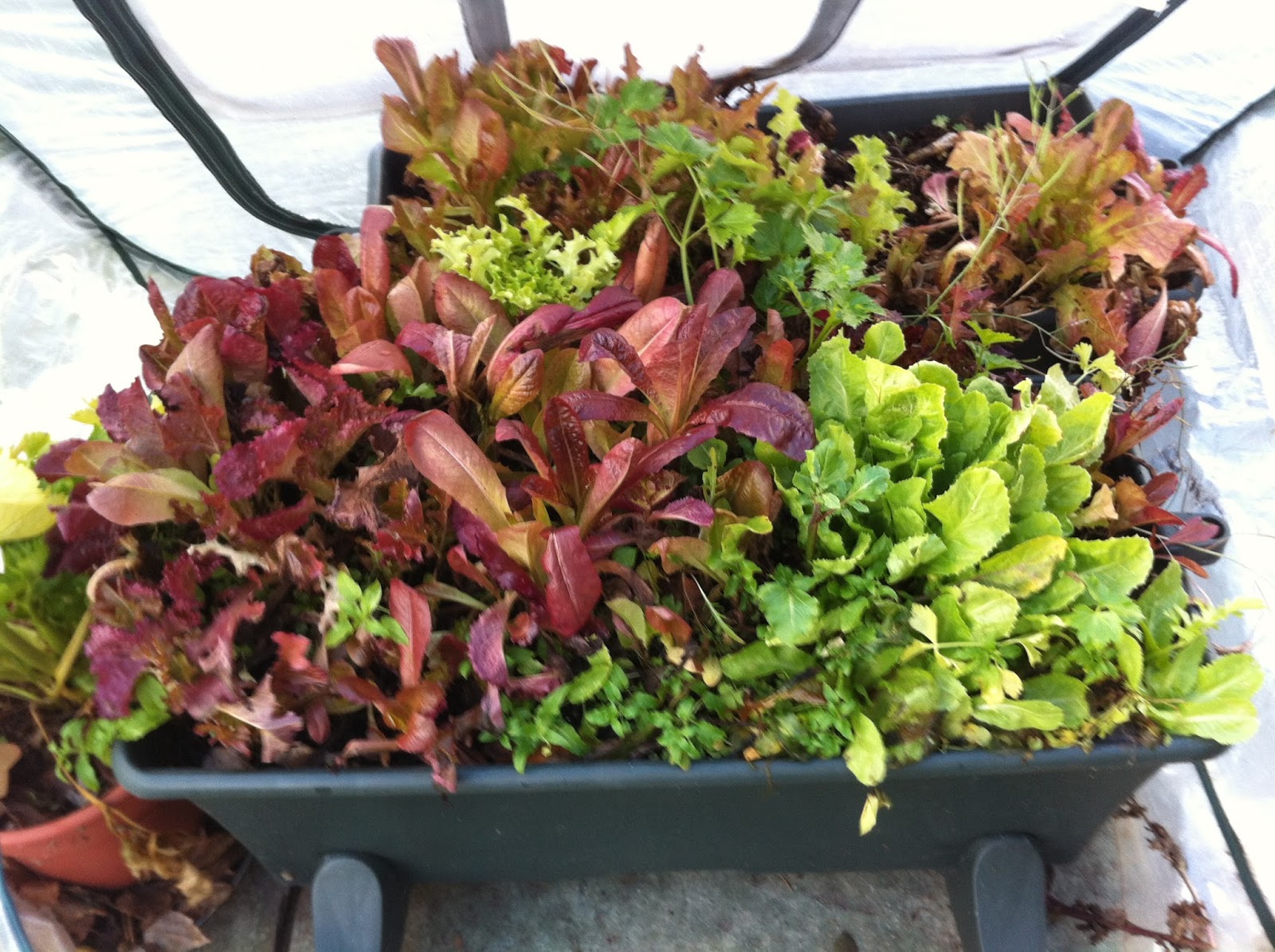
You can plant lettuce, spinach and other greens you would like to be able to make salads all winter in the location where you are going to cover with a portable green house.  I planted our greens in Earthboxes and then covered them with our portable green house shown above.

Sunday, September 8, 2013

Self sustaining gardening appealing? Try the self-seeders!


Chard
Sunday, September 8, 2013


Another viable option for a plant once and be done are self-seeders.  These are plants that produce many seeds.  One trick to self sowing is letting the seeds sprout before adding a thick layer of mulch which may dampen how many seedlings can push up through the crust if put down before they have a chance to sprout.

There are many self-seeding vegetable and herbs.  Here are a few we are growing:
*Arugula
*Dill
*Purslane
*Sorrel
*Basil
*Marigold
*Spinach
*Lettuce
*Chard
*Borage
*Mache (corn salad)
*Miner’s lettuce (claytonia)
*Giant Red mustard
*Cilantro
*Brilliant Red orach
*Celery
*Nasturtiums
*Chamomile
*Calendula
*Morning glory
*Sunflowers

The one caution with growing self sowing plants is that they can self sow a little too well.  The only one on the above list that I would not let loose in my garden is the purslane.  I only let it grow in pots.  The rest are easy to pluck out the ones you don’t need.